
Western Monasticism ante litteram
The Spaces of Monastic Observance in Late Antiquity and the Early Middle Ages
Edited by Hendrik Dey Edited by Elizabeth Fentress

Space has always played a crucial part in defining the place that monks and nuns occupy in the world. Even during the first centuries of the monastic phenomenon, when the possible varieties of monastic practice were nearly infinite, there was a common thread in the need to differentiate the monk from the rest: whatever else they were supposed to be, monks were beings apart, unique, in some sense separate from the mainstream. The physical contours of monastic topographies, natural and constructed, are thus fundamental to an understanding of how early monks went about defining the parameters of their everyday lives, their modes of religious observance, and their interactions with the larger world around them. The group of eminent historians and archaeologists present at the American Academy in Rome in March, 2007 for the conference ‘Western monasticism ante litteram. The spaces of early monastic observance,’ whose contributions comprise the bulk of this volume, have sought to reconsider the theory, the practice and above all the spaces of early monasticism in the West, in the hope of creating a more complete picture of that seminal period, from the fourth century until the ninth, when notions of what it meant to be a monk were as numerous as they were varied and (often) conflicting.
Space has always played a crucial part in defining the place that monks and nuns occupy in the world. Even during the first centuries of the monastic phenomenon, when the possible varieties of monastic practice were nearly infinite, there was a common thread in the need to differentiate the monk from the rest: whatever else they were supposed to be, monks were beings apart, unique, in some sense separate from the mainstream. The physical contours of monastic topographies, natural and constructed, are thus fundamental to an understanding of how early monks went about defining the parameters of their everyday lives, their modes of religious observance, and their interactions with the larger world around them. The group of eminent historians and archaeologists present at the American Academy in Rome in March, 2007 for the conference ‘Western monasticism ante litteram. The spaces of early monastic observance,’ whose contributions comprise the bulk of this volume, have sought to reconsider the theory, the practice and above all the spaces of early monasticism in the West, in the hope of creating a more complete picture of that seminal period, from the fourth century until the ninth, when notions of what it meant to be a monk were as numerous as they were varied and (often) conflicting.
- Edited by Hendrik Dey
- Edited by Elizabeth Fentress
Other Titles in this Series
 The Pursuit of Salvation
Community, Space, and Discipline in Early Medieval Monasticism: With a critical edition and translation of the Regula cuiusdam ad uirgines
Volume 13


 Consuetudines et Regulae
Sources for Monastic Life in the Middle Ages and the Early Modern Period
Volume 10

 ‘The Devout Belief of the Imagination’
The Paris 'Meditationes Vitae Christi' and Female Franciscan Spirituality in Trecento Italy
Volume 6
 Saint-Benigne de Dijon en l’an mil, ‘totius Galliae basilicis mirabilior’
Interpretation politique, liturgique et theologique
Volume 5
 Walls and Memory
The Abbey of San Sebastiano at Alatri (Lazio), from Late Roman Monastery to Renaissance Villa and Beyond
Volume 2
 From Dead of Night to End of Day
The Medieval Customs of Cluny: Du coeur de la nuit a la fin du jour: les coutumes clunisiennes au Moyen Age
Volume 3
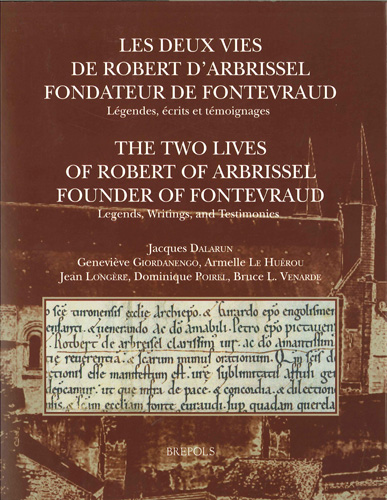 Les deux vies de Robert d’Arbrissel, fondateur de Fontevraud. Legendes, ecrits et temoignages
The Two Lives of Robert of Arbrissel, Founder of Fontevraud. Legends, Writings, and Testimonies

 Assistenza, ospitalità e ospedali presso monasteri e canoniche regolari del medioevo europeo: l’ospedale di Sant’Andrea di Vercelli in contesto
Care, Hospitality and Hospitals in Monasteries and Houses of Regular Canons in Medieval Europe: The Hospital of Sant’Andrea in Vercelli in Context
Volume 15

Similar Books
 A Collaborative Tapestry in Honour of Shirley Ann Brown / Une fresque brodée en l’honneur de Shirley Ann Brown
The Bayeux Tapestry Seen by her Colleagues and Friends / La Tapisserie de Bayeux vue par ses collègues et amis

 Behind the Scenes of Medieval Roofs
An Overview of the Roofing Systems of Italian Churches
Volume 90




 Drunk the Potion, No Whit Charmed
The Doctrine of Pure and Perfect Souls from Iamblichus to Damascius


 Epiphanies of the Divine in the Septuagint and the New Testament
Fifth International Symposium of the Corpus Judaeo-Hellenisticum Novi Testamenti (CJHNT), 14-17 May 2015, Nottingham




 Innovation and Medieval Communities
The Circulation of Ideas and Practices in and out of the Town (1200-1500)
Volume 63
 John Dunstaple Reading Boethius
John Dunstaple’s Annotations to Boethius’s “De institutione musica” in the Manuscript Oxford, Corpus Christi College Library, MS 118
 Language and Power in the Roman Empire and Early India
Hierarchy, Ambiguity, and the Art of Reading the Signs in Cosmopolitan Cultures
 Late Antique villae in the Balkans (3rd–7th c. AD): Current Research Questions and Perspectives
HAEMUS Companion to the Late Antique Balkans 1
Volume 4
 Linguistic and Cultural Dynamics in a Frontier Society
New Perspectives on Northeastern Bavaria and Western Bohemia in the Early Middle Ages
Volume 9

 Medieval Debates on Foreknowledge: Future Contingents, Prophecy, and Divination
Acts of the XXVII Annual Colloquium of the SIEPM, Trento 12-15 September 2023
Volume 31
 Medieval Yeghegis, Armenia
History, Archaeology, Society. Local Multiplicities and Global Connections of a Rural Centre on the Silk Road(s)

 Nurturing the Elite
Representations of Drinking, Eating, and Religious Vessels in Palmyrene Funerary Iconography
Volume 13



