
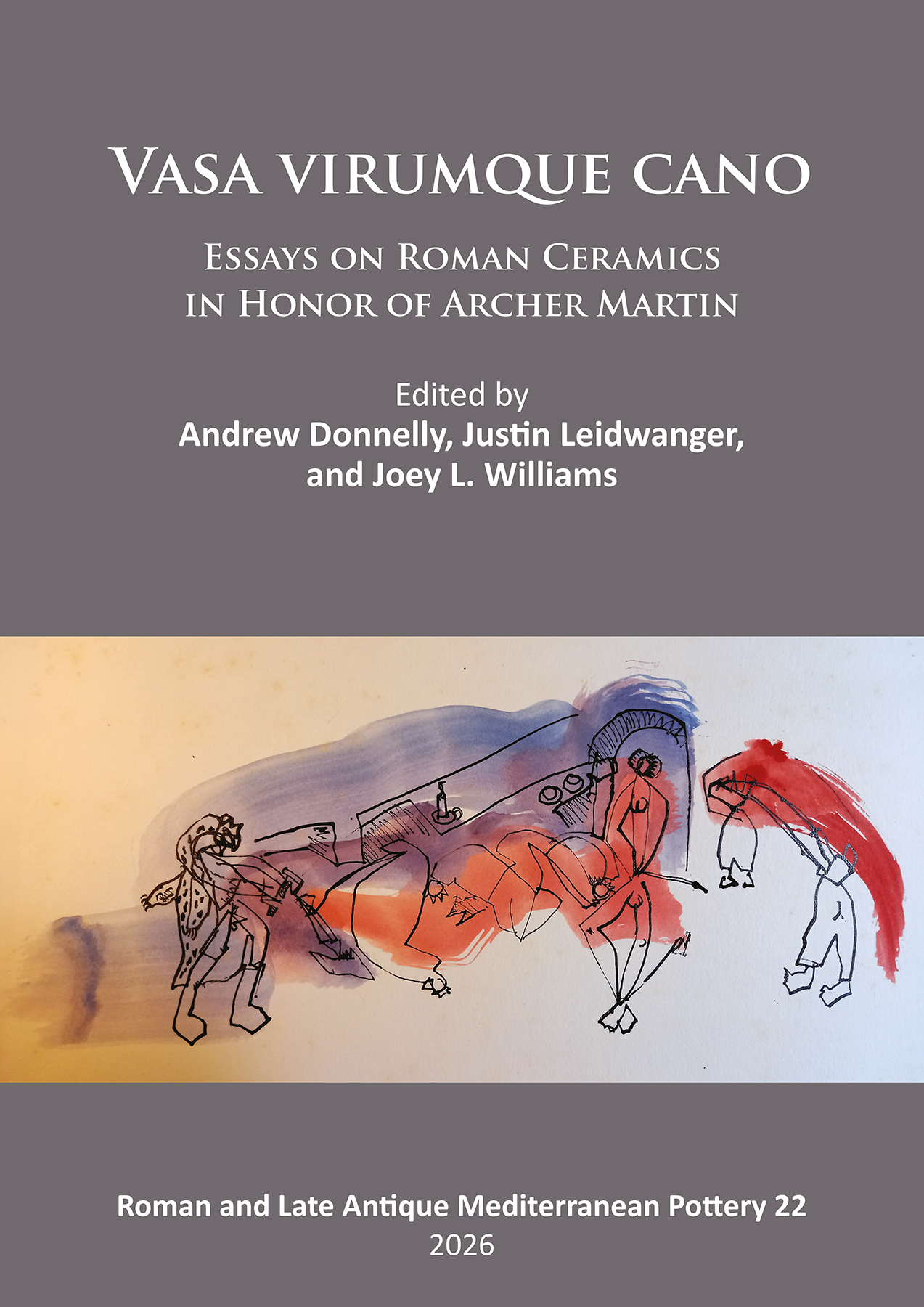
Vasa Virumque Cano: Essays on Roman Ceramics in Honor of Archer Martin
Paperback (Forthcoming)
(December 2026)
ISBN: 9781805833482
8.31 x 11.69 inches
Price: $77.00
Vasa virumque cano honours ceramicist and archaeologist Archer Martin through 25 chapters by students and collaborators. Exploring Mediterranean pottery, archaeological method and interdisciplinary research, the volume highlights Martin’s influence on ceramic studies, teaching and new approaches to understanding past societies.
Vasa virumque cano is an editorial collaboration by three former students of the celebrated ceramicist and archaeologist Archer Martin, and brings together 39 contributors across 25 chapters to honor the illustrious achievements of his scholarly and pedagogical career. Martin’s long tenure as one of the key figures in Mediterranean pottery studies has combined a rigorous and encyclopedic command of the ceramic record of forms and fabrics with new ways of using pottery to explore the lives and connections of past communities, all predicated on generous long-term collaborations, peripatetic and wide-ranging travels, and an inimitable command of languages and global scholarship. But Martin has also dedicated himself and this knowledge to training the next generation of ceramicists, most notably through his summer seminars. This volume examines the impact of his scholarship via the work of his students and collaborators, a cross-section of some of the most important ceramics researchers of several generations, whose scholarship on themes and approaches ranges from an art historical reassessment of a famous Etruscan krater, the anthropological understanding of the agency of small ceramic objects, and a ceramicist’s scrupulous detailing of the small evidence of repair of old vessels. Chapters include an examination of Martin’s importance in the redating of the castrum at Ostia; the role of ceramics in making the sweet perfumes of Pompeii, the necessity of interdisciplinarity in future ceramic research, and the application of Marti n’s method to a new generation of students.
Other Titles in this Series


 The Ovoid Amphorae in the Central and Western Mediterranean
Between the last two centuries of the Republic and the early days of the Roman Empire

 Scambi e commerci in area vesuviana
I dati delle anfore dai saggi stratigrafici I.E. (Impianto Elettrico) 1980-81 nel Foro di Pompei

 Ceramics and Atlantic Connections: Late Roman and Early Medieval Imported Pottery on the Atlantic Seaboard
Proceedings of an International Symposium at Newcastle University, March 2014
 Roman Pottery in the Near East: Local Production and Regional Trade
Proceedings of the round table held in Berlin, 19-20 February 2010


 Cerámica común romana y ciclo haliéutico
Análisis de los contextos de las cetariae de Iulia Traducta
 Ánforas vinarias de Hispania Citerior-Tarraconensis (s. I a.C.– I d.C.)
Caracterización arqueométrica
 LRFW 1. Late Roman Fine Wares. Solving problems of typology and chronology.
A review of the evidence, debate and new contexts


 LRCW 6: Late Roman Coarse Wares, Cooking Wares and Amphorae in the Mediterranean: Archaeology and Archaeometry
Land and Sea: Pottery Routes

 Once upon a Time in the East
The Chronological and Geographical Distribution of Terra Sigillata and Red Slip Ware in the Roman East
 Roman Amphora Contents: Reflecting on the Maritime Trade of Foodstuffs in Antiquity (In honour of Miguel Beltrán Lloris)
Proceedings of the Roman Amphora Contents International Interactive Conference (RACIIC) (Cadiz, 5-7 October 2015)
Similar Books


 Caesar’s Visions and Impact on the Roman Empire
Revisiting the Archaeological and Historical Record of the 40s BC
Volume 2


 Construction Processes in Historical Western Societies (5th c. BC – 10th c. AD)
Case Studies on Techniques, Models, and Costs
 Contesting Labeled Identities
The Sociology of Gentilics in Biblical and Northwest Semitic Literature

 Drunk the Potion, No Whit Charmed
The Doctrine of Pure and Perfect Souls from Iamblichus to Damascius

 Epigraphic “Shades” from Hellenistic Thrace
Contextualizing Inscriptions in Greek from Thracian Tombs

 Epiphanies of the Divine in the Septuagint and the New Testament
Fifth International Symposium of the Corpus Judaeo-Hellenisticum Novi Testamenti (CJHNT), 14-17 May 2015, Nottingham


 Etruscan and Roman Hellenistic Anatomical ex votos
Reassessing Popular Religious Expressions in Central Italy
Volume 8



 Gold, Silver and Glass: Power Networks, Cultural Identities, Technology Transfers and Agency across the Old World (7th Century BC – 1st Century AD)
Proceedings of a Conference Held at the British Museum, 16–18 June 2023


 Invisible Labour in Antiquity
Visualizing Obscure Work in the Ancient Mediterannean and West Asia
Volume 1

 Language and Power in the Roman Empire and Early India
Hierarchy, Ambiguity, and the Art of Reading the Signs in Cosmopolitan Cultures
 Late Antique villae in the Balkans (3rd–7th c. AD): Current Research Questions and Perspectives
HAEMUS Companion to the Late Antique Balkans 1
Volume 4





 Nurturing the Elite
Representations of Drinking, Eating, and Religious Vessels in Palmyrene Funerary Iconography
Volume 13


 Portraying the Individual in the Roman East
Local–Imperial Entanglements in Sculpture, Mosaics, and Paintings (First–Fourth Centuries AD)
Volume 18
