
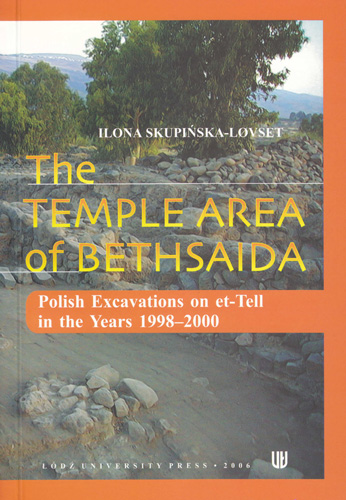
The Temple Area of Bethsaida
Polish Excavations on et-Tell in the Years 1998-2000
by Ilona Skupinska-Lovset
Paperback (Published)
(December 2006)
ISBN: 9788371719639
Price: $30.00
On back order
The village of Bethsaida and the polls of Julias have both been attested to in the first century AD. The New Testament tells about Bethsaida on multiple occasions. According to Josephus Flavius Bethsaida was refounded as Julias and the territory of this new foundation was certainly enlarged as new settlers were added to the original population of the village of Bethsaida. Thus Julias must have contained both the fishing village of Bethsaida and the new settlement. Of how these two units were spatially related to each other the literary sources do not speak. During the centuries various sites known under their modern names have been proposed as hiding the remains either of Bethsaida, of Bethsaida-Julias or of Julias. The controversy as to the placement of Bethsaida, however, was still unsolved in the twentieth century. Archaeological investigation of the most probable candidate to be named Bethsaida, et-Tell, an artificial hill dominating the area north of the modern shores of the Sea of Galilee, started in 1989. After a few seasons of field work the excavators indicated that the remains of the New Testament Bethsaida were indeed located at et-Tell. This identification was already acknowledged by the international society of scholars before the Polish mission joined the excavation. The year was 1998 and it was the first official Polish archaeological mission in Israel. The present report presents the results of field and library research of the years 1998-2000 relating principally to the squares containing the remains named the “The Temple of the Imperial Cult”. It is leaning on the research predating our engagement, comments on them and disputes them, at the end presenting a new conception of the reconstruction of the sacral area…
- By (author) Ilona Skupinska-Lovset
Similar Books





 Athanasius of Alexandria, Epistula ad episcopos Aegypti et Libyae
Old Slavonic Version and English Translation
Volume 261

 Caesar’s Visions and Impact on the Roman Empire
Revisiting the Archaeological and Historical Record of the 40s BC
Volume 2



 Connecting the Dots: Counting, Writing, and the Beginnings of Civilization
The Secret Lives of Clay Tokens: A Memoir


 Cyril of Alexandria’s Christological Exegesis
Explorations of Partitive Exegesis in the Dialogues on the Trinity
Volume 70


 Epiphanies of the Divine in the Septuagint and the New Testament
Fifth International Symposium of the Corpus Judaeo-Hellenisticum Novi Testamenti (CJHNT), 14-17 May 2015, Nottingham


 Etruscan and Roman Hellenistic Anatomical ex votos
Reassessing Popular Religious Expressions in Central Italy
Volume 8

 Exploring Gender Dynamics across the Ancient Near East
Collected Essays of Gender and Methodology in the Ancient Near East (GeMANE) 4 and 5
Volume 7
 Extracanonical Traditions and the Holy Land
Texts, Rituals, and Material Culture in Late Antique Palestine

 From Joseph to Jesus
The Joseph Narrative as a Compositional Template from Old Greek Esther to the Gospel of Luke
Volume 125


 Ḫattušaš utnē išḫameški
Hittite and Other Ancient Near Eastern Studies Presented to Piotr Taracha on the Occasion of His 65th Birthday



 Invisible Labour in Antiquity
Visualizing Obscure Work in the Ancient Mediterannean and West Asia
Volume 1



 Late Antique villae in the Balkans (3rd–7th c. AD): Current Research Questions and Perspectives
HAEMUS Companion to the Late Antique Balkans 1
Volume 4