
The East Side of the Agora
The Remains beneath the Stoa of Attalos
By (author) Rhys F. Townsend

Hardback (Published)
(December 1995)
ISBN: 9780876612279
9.02 x 12.01 inches
Price: $119.95
In stock
The Stoa of Attalos now covers the remains of several centuries of previous occupation. The author’s success in making a coherent and orderly presentation of the architectural history of the site rests on the care and diligence of the excavators as well as his own painstaking search through the records.
The Stoa of Attalos now covers the remains several centuries of previous occupation. Mycenaean and Protogeometric burials represent the early use of the area. By the Late Geometric period, the presence of a few wells indicates a shift to domestic occupation; others containing 6th-century B.C. material suggest the presence of workshops and commercial activity as well as houses. The earliest physical remains are those of an Archaic altar; some rubble structures may have been hastily built by refugees during the Peloponnesian War. At the end of the 5th century B.C., a group of public buildings was constructed, perhaps to house some of the lawcourts. About 300 B.C., these were replaced by an imposing structure, the Square Peristyle, which could have housed four lawcourts simultaneously, each with a jury of 500. Still unfinished when it was dismantled in the first quarter of the second century B.C., its materials were carefully reused in other projects, especially in South Stoa II. The evidence for these centuries is now limited to the meticulous records of the excavators and the finds now stored in the Stoa of Attalos, where some few remains still in situ are visible in the basement. The author’s success in making a coherent and orderly presentation rests on the care and diligence of the excavators as well as his own painstaking search through the records. The physical reconstruction is accompanied by a catalogue of architectural blocks; the discussion of the chronology is supported by the stratigraphic evidence and a catalogue of pottery.
- By (author) Rhys F. Townsend
Similar Books


 Behind the Scenes of Medieval Roofs
An Overview of the Roofing Systems of Italian Churches
Volume 90
 Caesar’s Visions and Impact on the Roman Empire
Revisiting the Archaeological and Historical Record of the 40s BC
Volume 2

 Circulation, Use, Impact
The Consumption of Architectural Books in the Early Modern Eastern Adriatic
Volume 1


 Drunk the Potion, No Whit Charmed
The Doctrine of Pure and Perfect Souls from Iamblichus to Damascius

 Epiphanies of the Divine in the Septuagint and the New Testament
Fifth International Symposium of the Corpus Judaeo-Hellenisticum Novi Testamenti (CJHNT), 14-17 May 2015, Nottingham


 Etruscan and Roman Hellenistic Anatomical ex votos
Reassessing Popular Religious Expressions in Central Italy
Volume 8




 Invisible Labour in Antiquity
Visualizing Obscure Work in the Ancient Mediterannean and West Asia
Volume 1
 Language and Power in the Roman Empire and Early India
Hierarchy, Ambiguity, and the Art of Reading the Signs in Cosmopolitan Cultures
 Late Antique villae in the Balkans (3rd–7th c. AD): Current Research Questions and Perspectives
HAEMUS Companion to the Late Antique Balkans 1
Volume 4


 Nurturing the Elite
Representations of Drinking, Eating, and Religious Vessels in Palmyrene Funerary Iconography
Volume 13


 Portraying the Individual in the Roman East
Local–Imperial Entanglements in Sculpture, Mosaics, and Paintings (First–Fourth Centuries AD)
Volume 18

 Small Worlds and Relational Agencies: Local Societies in Early Medieval Iberia
Pequeños mundos y Agencias relacionales: Sociedades locales altomedievales en la Península Ibérica

 The Compositional History of the Book of Kings
An Analysis of the Evaluative Frameworks in 1 Kings 14–2 Kings 25


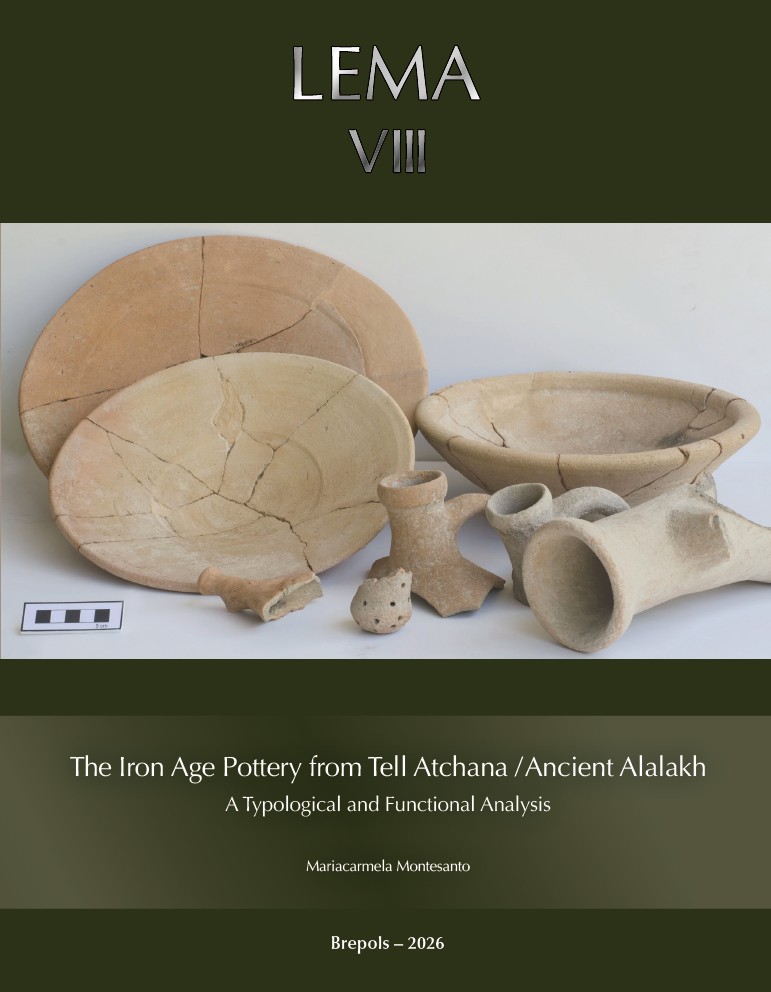 The Iron Age Pottery from Tell Atchana / Ancient Alalakh
A Typological and Functional Analysis
Volume 8



 Visual Memory and Oblivion
Monuments and Conflicts in Urban Spaces in Central and Eastern Europe from the Nineteenth Century to the Present Day
