
Terms of the Semantic Sphere of dike and themis in the Early Greek Epic
by Joanna Janik
Paperback (Published)
(December 2003)
ISBN: 9788388857546
Price: $18.00
On back order
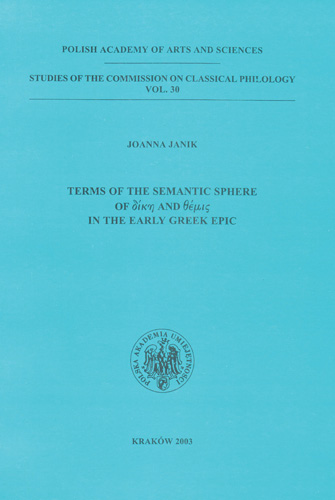
The aim of this study is to analyse the history of [Themis] and [Dike] in the early Greek literature, i.e. Homer and Hesiod. The subject has been discussed for a very long time and our survey is supposed to continue the debate. The interpretation of a term is always difficult and it is especially so when the sources are of strictly literary character. Works of literature are not supposed to define abstract notions, neither are they expected to describe in detail the ways in which the terms were used by the contemporary people. The study is based on the analysis of almost all passages where the terms [Themis], [Dike] and their derivatives appear. The aim of this procedure is to demonstrate the development of the abstract ideas of justice and order which, in the following centuries, will stand in the centre of Greek ethical thought. These terms are of particular interest because of their significance for the concept of a state and a society. [Themis], as well as [Dike], denoted norms, then laws and, eventually, the principle of justice, which ruled the human community and made social life possible.
The aim of this study is to analyse the history of [Themis] and [Dike] in the early Greek literature, i.e. Homer and Hesiod. The subject has been discussed for a very long time and our survey is supposed to continue the debate. The interpretation of a term is always difficult and it is especially so when the sources are of strictly literary character. Works of literature are not supposed to define abstract notions, neither are they expected to describe in detail the ways in which the terms were used by the contemporary people. The study is based on the analysis of almost all passages where the terms [Themis], [Dike] and their derivatives appear. The aim of this procedure is to demonstrate the development of the abstract ideas of justice and order which, in the following centuries, will stand in the centre of Greek ethical thought. These terms are of particular interest because of their significance for the concept of a state and a society. [Themis], as well as [Dike], denoted norms, then laws and, eventually, the principle of justice, which ruled the human community and made social life possible.
- By (author) Joanna Janik
Similar Books



 Ars Prophetica
Theology in the Poetry of Twentieth-Century Hebrew Poets Avraham Halfi, Shin Shalom, Amir Gilboa, and T. Carmi


 Cahiers de l’Association internationale des études françaises
J. M. G. Le Clézio - Enseigner les littératures francophones aujourd’hui - Récit de soi et expérience de l’illusion (XVIIe-XVIIIe siècles)
Volume 78
 Cahiers de littérature française
Les Métamorphoses du texte. Enjeux intertextuels et transpositions visuelles
Volume 25
 Cahiers de recherches médiévales et humanistes – Journal of Medieval and Humanistic Studies
Volume 51
 Cahiers de sémiotique des cultures
Ponctuation et sens. Nouvelles perspectives / Punctuation and meaning. New perspectives
Volume 6



 CompLit
Myth, Folklore and Magic in European Literatures. Critical and Contemporary Reconfigurations

 Contesting Labeled Identities
The Sociology of Gentilics in Biblical and Northwest Semitic Literature


 Dis/United States of Vulnerability
Literary and Cultural Transgressions in U.S. Poetry Since the 1960s
Volume 330
 Drunk the Potion, No Whit Charmed
The Doctrine of Pure and Perfect Souls from Iamblichus to Damascius


 Epigraphic “Shades” from Hellenistic Thrace
Contextualizing Inscriptions in Greek from Thracian Tombs

 Epiphanies of the Divine in the Septuagint and the New Testament
Fifth International Symposium of the Corpus Judaeo-Hellenisticum Novi Testamenti (CJHNT), 14-17 May 2015, Nottingham


 European Drama and Performance Studies
Dramatisations politiques. Théâtre, politique et idéologie au XIXe siècle (1806-1914)
Volume 27


