
Singing with Angels
Liturgy, Music, and Art in the Gradual of Gisela von Kerssenbrock
By (author) Judith Oliver
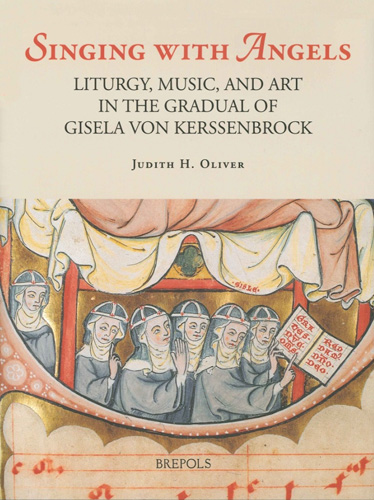
A prized possession of the Cistercian convent of Marienbrunn in Rulle near Osnabruck in northern Germany was its richly illuminated gradual dating to c. 1300, which is of great significance in the history of medieval art for several reasons. With 52 historiated initials iconographically complex in their literary quotations from the liturgy, the manuscript ranks as one of the most lavishly decorated books of its type to survive. Painted in an elegant courtly Gothic style, it is ascribed in a prefatory inscription to the nun Gisela von Kerssenbrock, who wrote, notated, and decorated the manuscript “with golden letters and beautiful images.” Such an encyclopedic listing of a scribe-artist’s labors is unparalleled in medieval scribal colophons. The high quality of the miniatures ranks her among the most gifted women artists of the Middle Ages. Gisela is depicted in two self-portraits within the manuscript, in one of which she is leading the nuns of Rulle in singing the Christmas hymn, visual evidence that she was the choirmistress at this convent. The manuscript’s images reflect the intellectual ambience of encloistered nuns who were steeped in the annual liturgical cycle of feasts with its associated bible readings, theological commentary, sermons, music, dramatic ritual, and artistic decoration. As it was used in the nuns’ daily celebration of the mass, the book is an eloquent witness of the communal religious life of medieval women rather than their private meditations or mystical experiences.This study explores the imagery and texts associated with major feasts of the liturgical year and the novel ways in which music and text are woven into the artistic program of Gisela’s manuscript. In particular, her book shows the seminal importance of the Easter celebration for convent life, as well over half of its illustrations are clustered in the Easter season; and the manuscript repeatedly gives artistic expression to the nuns’ hopes of heaven.
A prized possession of the Cistercian convent of Marienbrunn in Rulle near Osnabruck in northern Germany was its richly illuminated gradual dating to c. 1300, which is of great significance in the history of medieval art for several reasons. With 52 historiated initials iconographically complex in their literary quotations from the liturgy, the manuscript ranks as one of the most lavishly decorated books of its type to survive. Painted in an elegant courtly Gothic style, it is ascribed in a prefatory inscription to the nun Gisela von Kerssenbrock, who wrote, notated, and decorated the manuscript “with golden letters and beautiful images.” Such an encyclopedic listing of a scribe-artist’s labors is unparalleled in medieval scribal colophons. The high quality of the miniatures ranks her among the most gifted women artists of the Middle Ages. Gisela is depicted in two self-portraits within the manuscript, in one of which she is leading the nuns of Rulle in singing the Christmas hymn, visual evidence that she was the choirmistress at this convent. The manuscript’s images reflect the intellectual ambience of encloistered nuns who were steeped in the annual liturgical cycle of feasts with its associated bible readings, theological commentary, sermons, music, dramatic ritual, and artistic decoration. As it was used in the nuns’ daily celebration of the mass, the book is an eloquent witness of the communal religious life of medieval women rather than their private meditations or mystical experiences.This study explores the imagery and texts associated with major feasts of the liturgical year and the novel ways in which music and text are woven into the artistic program of Gisela’s manuscript. In particular, her book shows the seminal importance of the Easter celebration for convent life, as well over half of its illustrations are clustered in the Easter season; and the manuscript repeatedly gives artistic expression to the nuns’ hopes of heaven.
- By (author) Judith Oliver
Similar Books
 «Solazoxa festa, stradolze e stracomplia»
Festschrift für Raymund Wilhelm zum 65. Geburtstag mit Beiträgen zu Diskurstraditionen und mittelalterlicher Philologie
Volume 249
 A Collaborative Tapestry in Honour of Shirley Ann Brown / Une fresque brodée en l’honneur de Shirley Ann Brown
The Bayeux Tapestry Seen by her Colleagues and Friends / La Tapisserie de Bayeux vue par ses collègues et amis




 Balthasar Caymox of Nuremberg
Early Modern German Print Publishers: Popular Prints of the Seventeenth Century
 Behind the Scenes of Medieval Roofs
An Overview of the Roofing Systems of Italian Churches
Volume 90


 Cahiers de recherches médiévales et humanistes – Journal of Medieval and Humanistic Studies
Volume 51





 ENTANGLED AFRICA
Intra-African Relations Between Rain Forest and Mediterranean from Around 4,000 BCE to 1,500 CE



 Gold, Silver and Glass: Power Networks, Cultural Identities, Technology Transfers and Agency across the Old World (7th Century BC – 1st Century AD)
Proceedings of a Conference Held at the British Museum, 16–18 June 2023


 Innovation and Medieval Communities
The Circulation of Ideas and Practices in and out of the Town (1200-1500)
Volume 63
 John Dunstaple Reading Boethius
John Dunstaple’s Annotations to Boethius’s “De institutione musica” in the Manuscript Oxford, Corpus Christi College Library, MS 118
 Legal Visuality
Exegesis, Ambiguity, and Dissimulation of the Donation of Constantine in the Early Modern Period
 Listening to the Swan Song
More-than-Human Beings and Sounds in Literature and Culture Through the Ages


 Medieval Debates on Foreknowledge: Future Contingents, Prophecy, and Divination
Acts of the XXVII Annual Colloquium of the SIEPM, Trento 12-15 September 2023
Volume 31