Siege of Jerusalem
Edited by Michael Livingston

Paperback (Published)
(March 2005)
ISBN: 9781580440905
7.01 x 10 inches
Price: $14.95
In stock
The fourteenth-century Siege of Jerusalem has been called by Ralph Hanna the chocolate-covered tarantula of the alliterative movement for its apparent anti-Semitism and is, as Livingston notes in his introduction, simply difficult for twenty-first-century readers to like. The poem, which describes the destruction of the Second Temple by Roman forces in AD 70, is graphic in detail and unpleasant in its relish of the suffering of the Jews. But as Livingston points out, Like the gritty violence of Alliterative Morte Arthure, the gore in Siege is perhaps best read as a grim awareness of the terrible realities of war, not as a bloodthirsty and berserk cry for further bloodshed. The poem chronicles a historical war, and it is this historical quality that must stand out: the poem not only has resonances of the bloodshed that battle inevitably brings, but it also is, in a very literal sense, history. This is to say, the war is over. The vengeance of Jesus has been accomplished. The Siege-poet’s answer to the social-political-religious question of whether there is such a thing as a just war is that there was one: Titus and Vespasian’s vengeance for the death of Christ. . . . Further efforts to avenge Christ were unnecessary. . . . That the poem is a call to action and to crusade, then, seems to be a claim that is far less sustainable than its opposite: a call to peace and to remembrance.
Acknowledgments Introduction Introduction History of the Temple The Vengeance of Our Lord Tradition Date and Provenance of the Poem Overview of the Poem Initial Critical Issues: Genre, Jews, and Violence Sources for the Poem The End of the Fourteenth Century: The Idea of Just War The Structure of the Poem: Architecture of Divine Providence The Laud Manuscript and Its Vocabulary Manuscripts Siege of Jerusalem Explanatory Notes Textual Notes Bibliography, Acknowledgments
Introduction
History of the Temple
The Vengeance of Our Lord Tradition
Date and Provenance of the Poem
Overview of the Poem
Initial Critical Issues: Genre, Jews, and Violence
Sources for the Poem
The End of the Fourteenth Century: The Idea of Just War
The Structure of the Poem: Architecture of Divine Providence
The Laud Manuscript and Its Vocabulary
Manuscripts
Textual Notes
Bibliography
- Edited by Michael Livingston
Other Titles in this Series


 Two Middle English Prayer Cycles
Holkham, "Prayers and Meditations" and Simon Appulby, "Fruyte of Redempcyon"


 Guillaume de Machaut, The Complete Poetry and Music, Volume 1
The Debate Poems: Le Jugement dou Roy de Behaigne, Le Jugement dou Roy de Navarre, Le Lay de Plour
 Sentimental and Humorous Romances
Floris and Blancheflour, Sir Degrevant, The Squire of Low Degree, The Tournament of Tottenham, and The Feast of Tottenham




 The Dialogue of Solomon and Marcolf
A Dual-Language Edition from Latin and Middle English Printed Editions

 Christine de Pizan’s Advice for Princes in Middle English Translation
Stephen Scrope’s "The Epistle of Othea" and the Anonymous "Lytle Bibell of Knyghthod"


Similar Books
 A Collaborative Tapestry in Honour of Shirley Ann Brown / Une fresque brodée en l’honneur de Shirley Ann Brown
The Bayeux Tapestry Seen by her Colleagues and Friends / La Tapisserie de Bayeux vue par ses collègues et amis


 Ars Prophetica
Theology in the Poetry of Twentieth-Century Hebrew Poets Avraham Halfi, Shin Shalom, Amir Gilboa, and T. Carmi
 Behind the Scenes of Medieval Roofs
An Overview of the Roofing Systems of Italian Churches
Volume 90


 Cahiers de littérature française
Les Métamorphoses du texte. Enjeux intertextuels et transpositions visuelles
Volume 25






 European Drama and Performance Studies
Dramatisations politiques. Théâtre, politique et idéologie au XIXe siècle (1806-1914)
Volume 27


 Innovation and Medieval Communities
The Circulation of Ideas and Practices in and out of the Town (1200-1500)
Volume 63
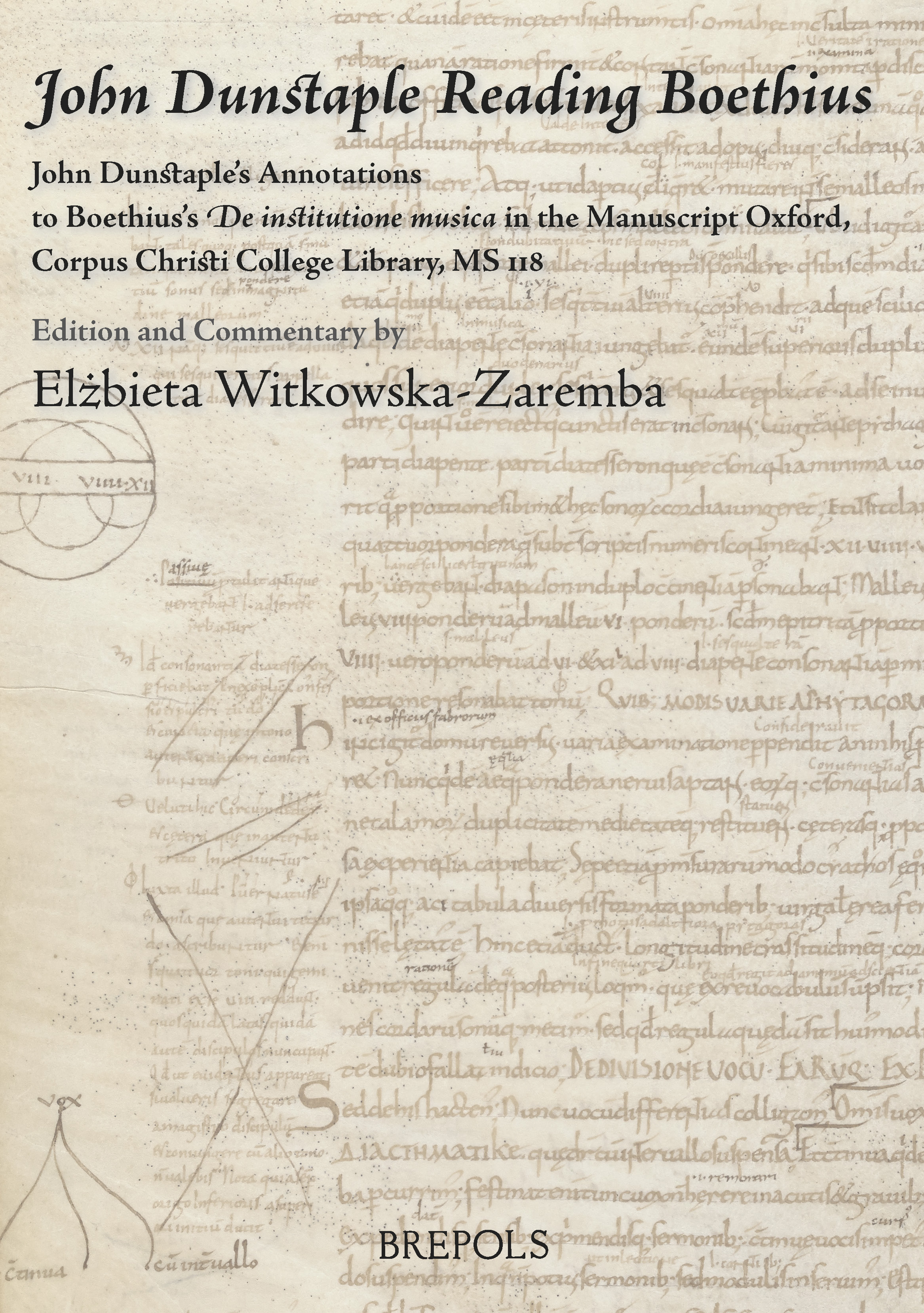 John Dunstaple Reading Boethius
John Dunstaple’s Annotations to Boethius’s “De institutione musica” in the Manuscript Oxford, Corpus Christi College Library, MS 118


 LiCArC
Trauma et création artistique : l’engagement des artistes arabes dans des dynamiques de résiliences
Volume 14

 Linguistic and Cultural Dynamics in a Frontier Society
New Perspectives on Northeastern Bavaria and Western Bohemia in the Early Middle Ages
Volume 9