
Shaping Sacred Space and Institutional Identity in Romanesque Mural Painting
Essays in Honour of Otto Demus
edited by Thomas E. A. Dale with John Mitchell
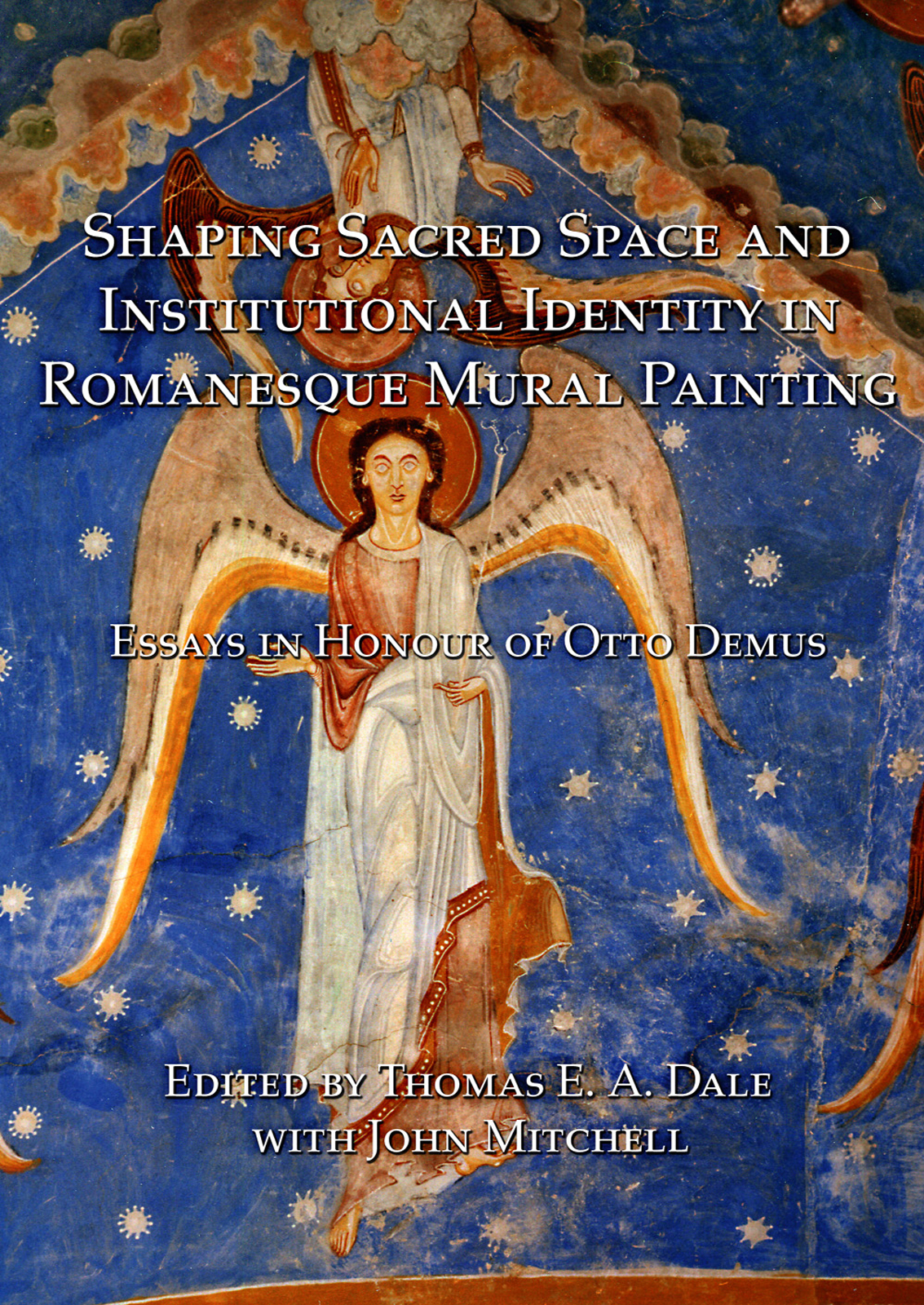
This collection of essays interprets Romanesque mural painting in Western churches, emphasizing its role in shaping religious spaces, institutional affiliations, and political agendas. The essays explore narratives, sanctity, burial crypts, and ecclesiastical politics, building upon Otto Demus’s pioneering work in the field.
Romanesque mural painting was arguably the most visible field for religious images in Western churches between the eleventh and thirteenth centuries. Beyond its traditional justification as Bible of the illiterate mural painting demarcated the principal functional spaces within the church and propagated the sacred narratives, the systems of belief and institutional politics. The present volume provides the first accessible collection of essays devoted exclusively to the contextual interpretation of Romanesque mural painting. They are offered in homage to Otto Demus, who established the essential parameters for the field with his unsurpassed survey of the field over thirty years ago. Presenting previously unpublished research on individual case studies from Italy, France and Spain, the collection of essays published here pursues Demus’s premise that mural painting was designed both to shape the experience and ritual use of distinctive spaces within the medieval church, and to advertise certain institutional affiliations and political agendas. The introduction, by Thomas Dale, provides a methodological overview to the field, assessing Demus’s contribution to the study of Romanesque mural painting and surveying the scholarship of the past thirty years. It also furnishes the first overview of primary texts that refer to the functions and exegesis of mural painting between the tenth and thirteenth centuries. The ten essays are grouped under four topics 1. Patterns of Narrative Disposition in Sacred Space 2. Reinforcing the Praesentia of the Saints: The Church as Locus Sanctus 3. The Burial Crypt as Mediator between the Living and the Dead, Terrestrial and Celestial Space 4. Ecclesiastical Politics and Institutional Identity.
- With John Mitchell
- Edited by Thomas E. A. Dale
Similar Books
 «Solazoxa festa, stradolze e stracomplia»
Festschrift für Raymund Wilhelm zum 65. Geburtstag mit Beiträgen zu Diskurstraditionen und mittelalterlicher Philologie
Volume 249
 A Collaborative Tapestry in Honour of Shirley Ann Brown / Une fresque brodée en l’honneur de Shirley Ann Brown
The Bayeux Tapestry Seen by her Colleagues and Friends / La Tapisserie de Bayeux vue par ses collègues et amis




 Balthasar Caymox of Nuremberg
Early Modern German Print Publishers: Popular Prints of the Seventeenth Century
 Behind the Scenes of Medieval Roofs
An Overview of the Roofing Systems of Italian Churches
Volume 90


 Cahiers de recherches médiévales et humanistes – Journal of Medieval and Humanistic Studies
Volume 51





 ENTANGLED AFRICA
Intra-African Relations Between Rain Forest and Mediterranean from Around 4,000 BCE to 1,500 CE



 Gold, Silver and Glass: Power Networks, Cultural Identities, Technology Transfers and Agency across the Old World (7th Century BC – 1st Century AD)
Proceedings of a Conference Held at the British Museum, 16–18 June 2023


 Innovation and Medieval Communities
The Circulation of Ideas and Practices in and out of the Town (1200-1500)
Volume 63
 John Dunstaple Reading Boethius
John Dunstaple’s Annotations to Boethius’s “De institutione musica” in the Manuscript Oxford, Corpus Christi College Library, MS 118
 Legal Visuality
Exegesis, Ambiguity, and Dissimulation of the Donation of Constantine in the Early Modern Period
 Listening to the Swan Song
More-than-Human Beings and Sounds in Literature and Culture Through the Ages


 Medieval Debates on Foreknowledge: Future Contingents, Prophecy, and Divination
Acts of the XXVII Annual Colloquium of the SIEPM, Trento 12-15 September 2023
Volume 31