
New Essays on Metaphysics as Scientia Transcendens
Proceedings of the Second International Conference of Medieval Philosophy, held at the Pontifical Catholic University of Rio Grande do Sul (PUCRS), Porto Alegre/Brazil, 15-18 August 2006
Edited by R Hofmeister Pich

This volume is not an historical study of the origins and development of medieval approaches to theories of transcendentals. Its point of departure is rather the role that transcendentals played in natural theology and metaphysical theories of the 13th. and 14th. centuries. Accordingly, the effort of John Duns Scotus (1265/6-1308) to systematize a theory of transcendental concepts provides the central inspiration for this book. The theories in focus are not only linked to metaphysical issues, but come to constitute the understanding of metaphysics as First Philosophy. In the wake of the 13th-century reception of Aristotle, Scotus inaugurates a new beginning for the science of reality as a whole, adumbrating theoretical elements that have exercised a remarkable influence on the history of philosophy and continue to do so today. If Scotus offers a new understanding and a new systematic account of transcendentals in the form of an original conception of First Philosophy as the science of transcendentals – a conception which many believe introduces a second beginning of metaphysics within Western philosophy – the essays in this volume evaluate the innovations that his work inspired, and in this sense each of them is itself innovative. They offer a candid evaluation of the extrinsic and intrinsic merits of the Scotist interpretation – that is, they examine just how original the intepretation is within the history of ideas, and assess its internal consistency. In doing so, they take account of earlier philosophical attempts to understand both the interrelationship of transcendentals and the science of metaphysics. They also offer topical and expanded analyses of various elements of Scotus’s theory, as well as of its influence and developments within Scotist circles and the Franciscan tradition, as well as within Spanish scholasticism and the philosophical theology of our times.
This volume is not an historical study of the origins and development of medieval approaches to theories of transcendentals. Its point of departure is rather the role that transcendentals played in natural theology and metaphysical theories of the 13th. and 14th. centuries. Accordingly, the effort of John Duns Scotus (1265/6-1308) to systematize a theory of transcendental concepts provides the central inspiration for this book. The theories in focus are not only linked to metaphysical issues, but come to constitute the understanding of metaphysics as First Philosophy. In the wake of the 13th-century reception of Aristotle, Scotus inaugurates a new beginning for the science of reality as a whole, adumbrating theoretical elements that have exercised a remarkable influence on the history of philosophy and continue to do so today. If Scotus offers a new understanding and a new systematic account of transcendentals in the form of an original conception of First Philosophy as the science of transcendentals – a conception which many believe introduces a second beginning of metaphysics within Western philosophy – the essays in this volume evaluate the innovations that his work inspired, and in this sense each of them is itself innovative. They offer a candid evaluation of the extrinsic and intrinsic merits of the Scotist interpretation – that is, they examine just how original the intepretation is within the history of ideas, and assess its internal consistency. In doing so, they take account of earlier philosophical attempts to understand both the interrelationship of transcendentals and the science of metaphysics. They also offer topical and expanded analyses of various elements of Scotus’s theory, as well as of its influence and developments within Scotist circles and the Franciscan tradition, as well as within Spanish scholasticism and the philosophical theology of our times.
- Edited by R Hofmeister Pich
Other Titles in this Series

 Frontiers in the Middle Ages
Proceedings of the Third European Congress of the Medieval Studies (Jyvaskyla, 10-14 June 2003)
Volume 35

 Hagiography in Anglo-Saxon England
Adopting and Adapting Saints' Lives into Old English Prose (c. 950-1150)
Volume 73


 Appropriation, Interpretation and Criticism
Philosophical and Theological Exchanges Between the Arabic, Hebrew, and Latin Intellectual Traditions
Volume 88
 Form and content of instruction in Anglo-Saxon England in the light of contemporary manuscript evidence
Papers presented at the International Conference, Udine, 6-8 April 2006
Volume 39


 Les Auctoritates Aristotelis, leur utilisation et leur influence chez les auteurs medievaux
Etat de la question 40 ans apres la publication
Volume 83


 Reading Sacred Scripture with Thomas Aquinas
Hermeneutical Tools, Theological Questions and New Perspectives
Volume 80

 Metaphysics in the Twelfth Century
On the Relationship among Philosophy, Science and Theology
Volume 19


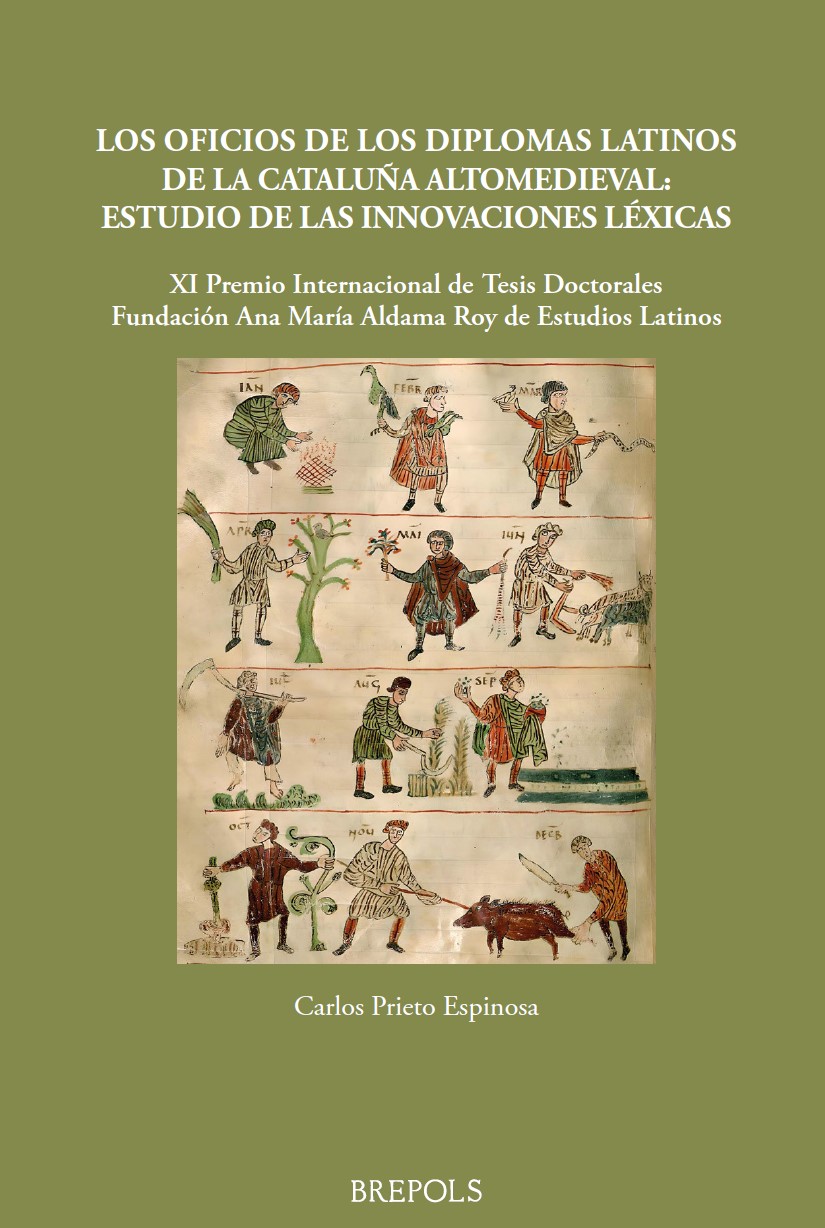 Los oficios de los diplomas latinos de la Cataluna altomedieval
Estudio de las innovaciones lexicas: XI Premio Internacional de Tesis Doctorales Fundacion Ana Maria Aldama Roy de Estudios Latinos
Volume 106
 Dictionarium Latinum Andrologiae, Gynecologiae et Embryologiae u Diccionario Latino de Andrologia, Ginecologia y Embriologia
Ab Antiquitate usque ad XVI saeculum u Desde la Antiguedad hasta el siglo XVI
Volume 74
 Rethinking and Recontextualizing Glosses
New Perspectives in the Study of Late Anglo-Saxon Glossography
Volume 54
 Individui universali. Il realismo di Gualtiero di Mortagne nel XII secolo
IV Premio Internacional de Tesis Doctorales, Fundacion Ana Maria Aldama Roy de Estudios Latinos
Volume 85
 L’humain, le réel et le divin
Implications philosophiques et théologiques de l’eucharistie, 11e18e siècle
Volume 108
 Il Calamo dell’esistenza
La corrispondenza epistolare tra Sadr al-din al-Qunawi e Nasir al-Din al-Tusi
Volume 92
 Anselm of Canterbury (1033-1109). Philosophical Theology and Ethics
Proceedings of the Third International Conference of Medieval Philosophy, held at the Pontifical Catholic University of Rio Grande do Sul (PUCRS), Porto Alegre / Brazil (02-04 September 2009)
Volume 60
 Secrets and Discovery in the Middle Ages
Proceedings of the 5th European Congress of the Federation Internationale des Instituts d'Etudes Medievales (Porto, 24 to 29 June 2013)
Volume 90

Similar Books
 «Solazoxa festa, stradolze e stracomplia»
Festschrift für Raymund Wilhelm zum 65. Geburtstag mit Beiträgen zu Diskurstraditionen und mittelalterlicher Philologie
Volume 249
 A Collaborative Tapestry in Honour of Shirley Ann Brown / Une fresque brodée en l’honneur de Shirley Ann Brown
The Bayeux Tapestry Seen by her Colleagues and Friends / La Tapisserie de Bayeux vue par ses collègues et amis



 Behind the Scenes of Medieval Roofs
An Overview of the Roofing Systems of Italian Churches
Volume 90


 Cahiers de recherches médiévales et humanistes – Journal of Medieval and Humanistic Studies
Volume 51





 Drunk the Potion, No Whit Charmed
The Doctrine of Pure and Perfect Souls from Iamblichus to Damascius



 Éthique, politique, religions
Superstition (XVIIe - XXIe siècles). Sémantique, histoires et cultures


 Innovation and Medieval Communities
The Circulation of Ideas and Practices in and out of the Town (1200-1500)
Volume 63
 John Dunstaple Reading Boethius
John Dunstaple’s Annotations to Boethius’s “De institutione musica” in the Manuscript Oxford, Corpus Christi College Library, MS 118
 La Lettre clandestine
La littérature philosophique clandestine, ses éditeurs et ses éditions
Volume 34
 Libertinage et philosophie à l’époque classique (XVIe-XVIIIe siècle)
Athéisme, Modernité et Sécularisation / Atheism, Modernity and Secularization
Volume 23

 Medieval Debates on Foreknowledge: Future Contingents, Prophecy, and Divination
Acts of the XXVII Annual Colloquium of the SIEPM, Trento 12-15 September 2023
Volume 31

 Medieval Yeghegis, Armenia
History, Archaeology, Society. Local Multiplicities and Global Connections of a Rural Centre on the Silk Road(s)


 Nicholas of Lyra’s Commentaries on the Gospels of Matthew and Luke
Franciscan Exegesis in a Time of Crisis
