
La sculpture de Thasos. Corpus des reliefs II
Reliefs à thème héroïque
By (author) B. Holtzmann
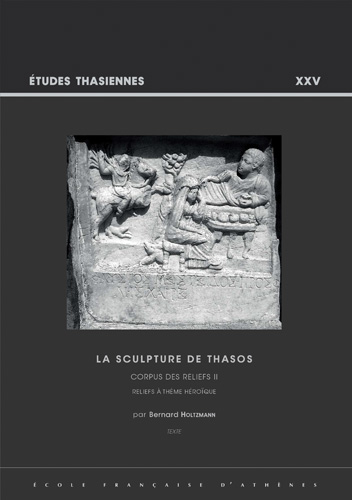
The heroes – mortals whom the Greeks worshiped in order to perpetuate their strong personnality – took pride of place in Thasos: every year the city celebrated the feast, otherwise unknown, of Heroxenia. This explains the large number of heroic reliefs that have been discovered in Thasos since the mid-nineteenth century. This volume brings together over two hundred reliefs, unevenly divided between two themes: the rider, and more importantly, the banqueter, both of aristocratic origin. In Thasos, the evolution of these themes can be followed more closely than in any other city, over eight centuries. Until the Hellenistic period, these reliefs are votives: rare and ambitious, they are the work of very skilled sculptors. The famous banquet relief from Thasos at the Museum of Istanbul is one of the masterpieces of its kind, probably from the same artistic background as the painter Polygnotos of Thasos, famous for his mural compositions. From the end of the fourth century, the spread of heroisation, progressively extended to the common people, sees these reliefs move from votive to funerary, at the cost of changes to their morphology and composition. For the rider, the late success of the boar hunter is linked to the rise, in northern Greece and the Balkans, of the cult of Heron/s, a Thracian god who can be easily assimilated with the greek hero. As for the banquet, stripped of its accessories, it becomes no more than a family scene, produced by workshops of funerary art with limited skills.
- By (author) B. Holtzmann
Other Titles in this Series
 Corpus des inscriptions de Thasos V
Documents publics d'époque romaine, Ier s. av. J.-C. - IVe s. apr. J.-C.
Volume 28
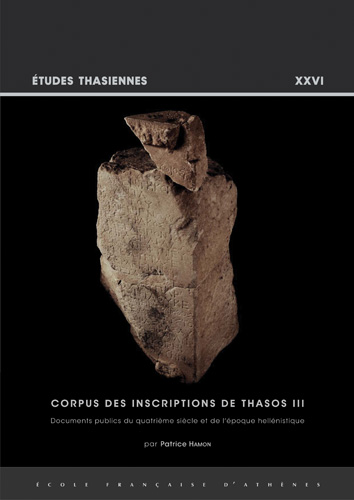 Corpus des inscriptions de Thasos III
Documents publics du quatrième siècle et de l'époque hellénistique
Volume 26
Similar Books
 A Collaborative Tapestry in Honour of Shirley Ann Brown / Une fresque brodée en l’honneur de Shirley Ann Brown
The Bayeux Tapestry Seen by her Colleagues and Friends / La Tapisserie de Bayeux vue par ses collègues et amis



 Balthasar Caymox of Nuremberg
Early Modern German Print Publishers: Popular Prints of the Seventeenth Century


 Caesar’s Visions and Impact on the Roman Empire
Revisiting the Archaeological and Historical Record of the 40s BC
Volume 2



 Construction Processes in Historical Western Societies (5th c. BC – 10th c. AD)
Case Studies on Techniques, Models, and Costs
 Contesting Labeled Identities
The Sociology of Gentilics in Biblical and Northwest Semitic Literature


 Drunk the Potion, No Whit Charmed
The Doctrine of Pure and Perfect Souls from Iamblichus to Damascius

 ENTANGLED AFRICA
Intra-African Relations Between Rain Forest and Mediterranean from Around 4,000 BCE to 1,500 CE
 Epigraphic “Shades” from Hellenistic Thrace
Contextualizing Inscriptions in Greek from Thracian Tombs

 Epiphanies of the Divine in the Septuagint and the New Testament
Fifth International Symposium of the Corpus Judaeo-Hellenisticum Novi Testamenti (CJHNT), 14-17 May 2015, Nottingham


 Etruscan and Roman Hellenistic Anatomical ex votos
Reassessing Popular Religious Expressions in Central Italy
Volume 8



 Gold, Silver and Glass: Power Networks, Cultural Identities, Technology Transfers and Agency across the Old World (7th Century BC – 1st Century AD)
Proceedings of a Conference Held at the British Museum, 16–18 June 2023




 Invisible Labour in Antiquity
Visualizing Obscure Work in the Ancient Mediterannean and West Asia
Volume 1