
Interweaving Innocence
A Rhetorical Analysis of Luke's Passion Narrative (Lk 22:66-23:49)
by Heather M. Gorman
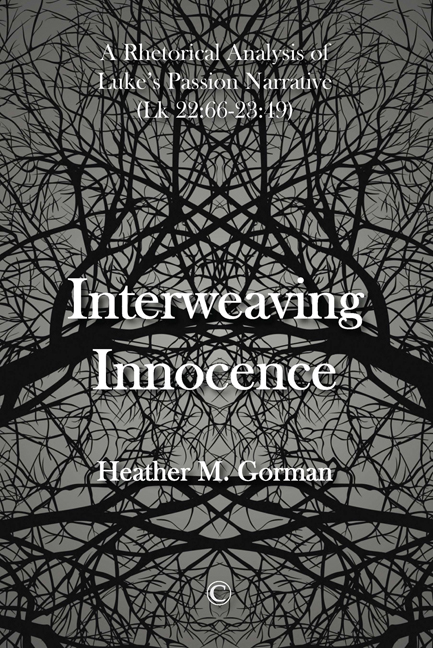
A study of the rhetorical techniques employed by the passion narrative in the Gospel of Luke, and how these shed new light on Luke’s themes, characterisation and narrative sources.
In this study Heather Gorman analyses Luke’s portrayal of Jesus’ death in light of the ancient rhetorical tradition, particularly the progymnasmata and the rhetorical handbooks. In addition to providing a detailed, up-to-date exegetical study of Luke 22:66-23:49, she argues three things. First, through the strategic placement of rhetorical figures and the use of common topics associated with refutation and confi rmation, Luke structures his passion narrative as a debate about Jesus’ innocence, which suggests that one of Luke’s primary concerns is to portray Jesus as politically innocent. Second, ancient examples of synkrisis suggest that part of the purpose of Luke’s characterisation of Jesus in the passion narrative, especially when set in parallel to Paul and Stephen in Acts, was to set up Jesus as a model for his followers lest they face similar persecution or death. Finally, Luke’s special material and his variations from Mark are explicable in terms of ancient compositional techniques, especially paraphrase and narration, and thus recourse to a special Passion Source is unnecessary.
Heather M. Gorman, PhD, is Assistant Professor of New Testament at Johnson University in Knoxville, Tennessee.
- By (author) Heather M. Gorman
'With careful analysis and clear prose Gorman provides a new lens for exploring some of the most oft-debated features of Luke's passion narrative. Highlighting practices from classical rhetoric, Gorman makes a compelling case for Luke's careful shaping of Mark to reinforce his emphasis on Jesus's political innocence. In this way, Gorman firmly establishes Jesus's innocence as a primary theme in Luke's account, one that stands as a model for Jesus's disciples in Acts and beyond." Alicia D. Meyers, Assistant Professor of New Testament and Greek, Campbell University Divinity School "In Interweaving Innocence, Dr. Gorman brings a fresh look at Luke's passion narrative. She helpfully moves the discussion on the formation and shape of Luke's passion narrative beyond simple source critical solutions. Employing a sophisticated knowledge of ancient rhetorical practices, the well-argued thesis is that Luke's rhetorical composition technique adequately explains significant variations from Mark's account without recourse to a non-canonical source. This is a must-read for Lukan scholars." Mark A. Matson, Milligan College, Co-chair, Gospel of Luke section, SBL annual meeting "[Interweaving Innocence] offers significant insights which complement source, literary or redaction-critical perspectives in exploring the sophisticated nuances of Luke's narrative artistry.... This is a noteworthy gracious contribution to Lukan studies which will richly reward attentive analysis." Anthony O'Leary, Journal for the Study of The New Testament: Booklist 2017, Volume 39.5, August 2017 "[Interweaving Innocence] remains a very good survey of the Passion account and Luke's characteristic shaping of it. Even if one is not persuaded by Gorman's specific conclusions, there is still much to gain from engaging with the close textual attention she encourages." David M. Allen, Reviews in Religion and Theology, Volume 24 Issue 4, October 2017 "This book is highly recommended to those with interest in the Lucan passion in particular, and in the principles of Gospel composition in general." Shelly Matthews, Brite Divinity School, Fort Worth, TX 76110, The Catholic Biblical Quarterly vol.80 no.4 / October 2018 pp.726-7
—
Similar Books




 Cyril of Alexandria’s Christological Exegesis
Explorations of Partitive Exegesis in the Dialogues on the Trinity
Volume 70


 Extracanonical Traditions and the Holy Land
Texts, Rituals, and Material Culture in Late Antique Palestine
 From Joseph to Jesus
The Joseph Narrative as a Compositional Template from Old Greek Esther to the Gospel of Luke
Volume 125


 Nicholas of Lyra’s Commentaries on the Gospels of Matthew and Luke
Franciscan Exegesis in a Time of Crisis

 Punning in Odd or Elegant Constructions in Jeremiah
The Convergence of Linguistics, Rhetoric, and Textuality in the Hebrew Text of Jeremiah


 Reformed Covenantal Eudaimonism
Wilhelmus à Brakel (1635–1711) on Highest Good, Virtue, and Law
Volume 87


 The Biblical Tale of Judah and Tamar in Fourteenth-Century Iran
A Judeo-Persian Versified Account by Shāhīn with Scholarly Edition, Annotated Translation and Persian Transliteration
Volume 94, 951
 The Body
Lived, Cultured, Adorned: Essays on Dress and the Body in the Bible and Ancient Near East in Honor of Nili S. Fox






 The Therapeutae as the Best Paradigm for the Contemplative Life
A Contextual Reading of Philo of Alexandria's De Vita Contemplativa

