
Ercolano
1927-1961. L'impresa archeologica di Amedeo Maiuri e l'esperimento della citta museo
edited by Domenico Camardo and Mario Notomista

Paperback (Published)
(August 2017)
ISBN: 9788891312631
9.65 x 10.98 inches
Price: $207.00
In stock
This volume is published in time to celebrate the 90th anniversary of the launch of excavations at Herculaneum by Amedeo Maiuri. Thanks to the Herculaneum Conservation Project which has been studying and conserving the archaeological site for over a decade, the authors have come into daily contact with the results of Maiuri’s extraordinary legacy of excavation and restoration that he carried out from 1927 to 1961. His ambitious dream to uncover the ancient Roman city was fulfilled by organizing every step of site works from excavation to restoration efficiently, through to the on-site display of the most significant finds. In this way the site became a sort of open-air museum in which the artefacts were contextualised; not just works of ancient art but mainly those finds which illustrated daily life in the past. Unfortunately, over the years as visitor numbers increased so did the risk of theft and damage to the objects, leading over time to their removal to storerooms. Maiuri’s innovative experiment to make Herculaneum an open-air museum was gradually forgotten. The first part of the volume, by Domenico Camardo and Mario Notomista, follows the personal and professional life of Amedeo Maiuri, from his early experiences in Greece through to his return to Naples as superintendent, when he turned his attention to Herculaneum. There then follows a contribution by Paola Pesaresi who reconstructs how he organized his site works and discusses his restoration methodology at Herculaneum. Andrew Wallace-Hadrill’s chapter explores instead Maiuri’s extraordinary abilities as an advocate for Herculaneum, raising awareness of its significance among the general public. Massimo Osanna also focuses on Maiuri’ s abilities as a communicator, but this time through the series of displays he set up within the archaeological spaces at Pompeii and Herculaneum. In the third part of the volume, the editors provide a full catalogue of the on-site displays that Maiuri created at Herculaneum, well illustrated with plans and archive images. The volume then finales with an extraordinary selection of over 130 archive photographs, most of them previously unpublished, that allow the reader greater understanding of Amedeo Maiuri’s major archaeological venture at Herculaneum.
This volume is published in time to celebrate the 90th anniversary of the launch of excavations at Herculaneum by Amedeo Maiuri. Thanks to the Herculaneum Conservation Project which has been studying and conserving the archaeological site for over a decade, the authors have come into daily contact with the results of Maiuri’s extraordinary legacy of excavation and restoration that he carried out from 1927 to 1961. His ambitious dream to uncover the ancient Roman city was fulfilled by organizing every step of site works from excavation to restoration efficiently, through to the on-site display of the most significant finds. In this way the site became a sort of open-air museum in which the artefacts were contextualised; not just works of ancient art but mainly those finds which illustrated daily life in the past. Unfortunately, over the years as visitor numbers increased so did the risk of theft and damage to the objects, leading over time to their removal to storerooms. Maiuri’s innovative experiment to make Herculaneum an open-air museum was gradually forgotten. The first part of the volume, by Domenico Camardo and Mario Notomista, follows the personal and professional life of Amedeo Maiuri, from his early experiences in Greece through to his return to Naples as superintendent, when he turned his attention to Herculaneum. There then follows a contribution by Paola Pesaresi who reconstructs how he organized his site works and discusses his restoration methodology at Herculaneum. Andrew Wallace-Hadrill’s chapter explores instead Maiuri’s extraordinary abilities as an advocate for Herculaneum, raising awareness of its significance among the general public. Massimo Osanna also focuses on Maiuri’ s abilities as a communicator, but this time through the series of displays he set up within the archaeological spaces at Pompeii and Herculaneum. In the third part of the volume, the editors provide a full catalogue of the on-site displays that Maiuri created at Herculaneum, well illustrated with plans and archive images. The volume then finales with an extraordinary selection of over 130 archive photographs, most of them previously unpublished, that allow the reader greater understanding of Amedeo Maiuri’s major archaeological venture at Herculaneum.
- Edited by Domenico Camardo
- Edited by Mario Notomista
Other Titles in this Series
 Contributi di archeologia vesuviana III
I culti di Pompei Raccolta critica della documentazione (Lorenza Barnabei). La norme a Pompei (Ier siecle avant - Ier siecle apres J. C.) Colloque organise par Marie-Odile Charles-Laforge. Centre Jacob Spon, Romanitas, Lyon - le 17 Novembre 2004
Volume 21
 Contributi di archeologia vesuviana II
Un tempio di Esculapio a Pompei (Marcattili Francesco). La Casa dei dioscuri di Pompei (VI, 9, 6.7): una nuova lettura (Lucia Romizzi). Le Complexe des rites magiques et le culte de Sabazios a Pompei (Marie-Odile Charles-Laforge). Sacrifices et march
Volume 18


 Marmora Pompeiana nel Museo archeologico Nazionale di Napoli
Gli arredi scultorei delle case pompeiane
Volume 26


 Nuove ricerche archeologiche nell’area vesuviana (scavi 2003-2006)
Atti del Convegno Internazionale, Roma 1-3 febbraio 2007
Volume 25


 Contributi di archeologia vesuviana I
Le boutiques et les ateliers de l'insula VI a Erculanum ( Nicolas Monteix). Complesso d'Orfeo, domus VI, 14, 18-20 e VI 14, 12: quadro architettonico e cronologico (Il). (G. Peris Bulighin)
Volume 17
Similar Books

 Caesar’s Visions and Impact on the Roman Empire
Revisiting the Archaeological and Historical Record of the 40s BC
Volume 2


 Drunk the Potion, No Whit Charmed
The Doctrine of Pure and Perfect Souls from Iamblichus to Damascius

 Epiphanies of the Divine in the Septuagint and the New Testament
Fifth International Symposium of the Corpus Judaeo-Hellenisticum Novi Testamenti (CJHNT), 14-17 May 2015, Nottingham


 Etruscan and Roman Hellenistic Anatomical ex votos
Reassessing Popular Religious Expressions in Central Italy
Volume 8




 Invisible Labour in Antiquity
Visualizing Obscure Work in the Ancient Mediterannean and West Asia
Volume 1
 Language and Power in the Roman Empire and Early India
Hierarchy, Ambiguity, and the Art of Reading the Signs in Cosmopolitan Cultures
 Late Antique villae in the Balkans (3rd–7th c. AD): Current Research Questions and Perspectives
HAEMUS Companion to the Late Antique Balkans 1
Volume 4

 Nurturing the Elite
Representations of Drinking, Eating, and Religious Vessels in Palmyrene Funerary Iconography
Volume 13


 Portraying the Individual in the Roman East
Local–Imperial Entanglements in Sculpture, Mosaics, and Paintings (First–Fourth Centuries AD)
Volume 18

 Small Worlds and Relational Agencies: Local Societies in Early Medieval Iberia
Pequeños mundos y Agencias relacionales: Sociedades locales altomedievales en la Península Ibérica
 The Compositional History of the Book of Kings
An Analysis of the Evaluative Frameworks in 1 Kings 14–2 Kings 25

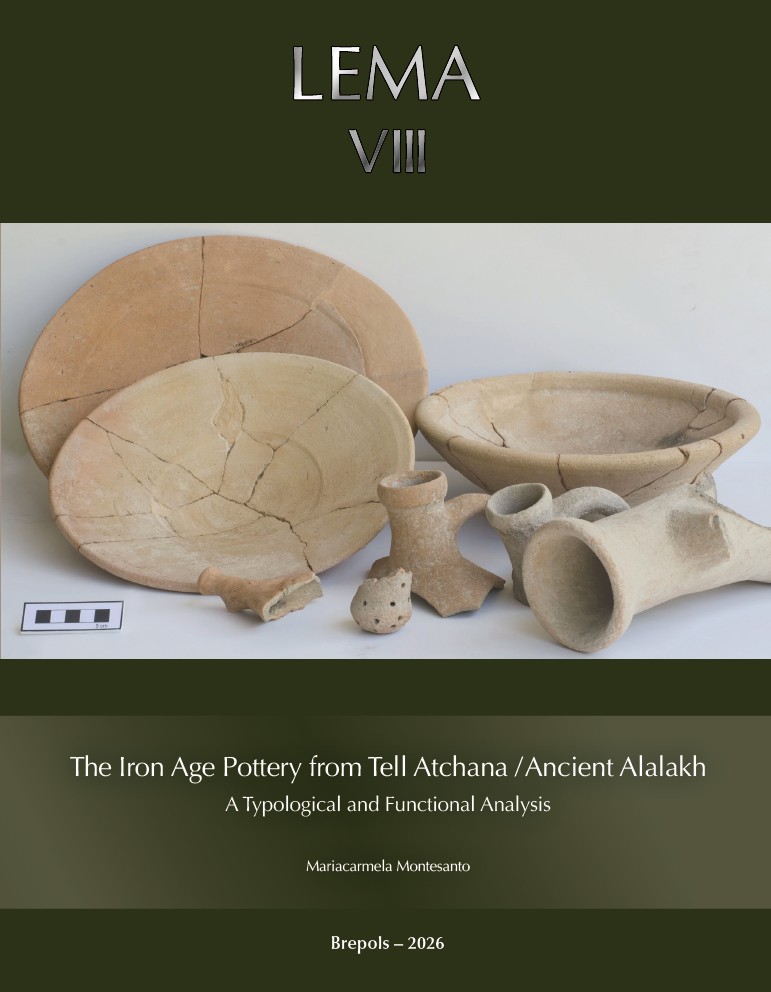 The Iron Age Pottery from Tell Atchana / Ancient Alalakh
A Typological and Functional Analysis
Volume 8


 Writing in the Church of the Nativity in Bethlehem
Inscription and Graffiti in a Multilingual and Multigraphic Perspective
Volume 45
 Contesting Labeled Identities
The Sociology of Gentilics in Biblical and Northwest Semitic Literature


 After Life in Roman Paganism. L’Égypte des astrologues. Les Mages hellénisés
Introductions historiographiques
Volume 7

 Atlante tematico di topografia antica 36-2026
Urbanistica e monumenti, porti, Roma. Ricerche sui monti Aurunci
Volume 36
 Cerámica común romana y ciclo haliéutico
Análisis de los contextos de las cetariae de Iulia Traducta


 Diodor über den ersten Sklavenaufstand auf Sizilien
Ein philologischer und historischer Kommentar
Volume 67