
Dressing the Part
Textiles as Propaganda in the Middle Ages
edited by K. Dimitrova and Margaret Goehring
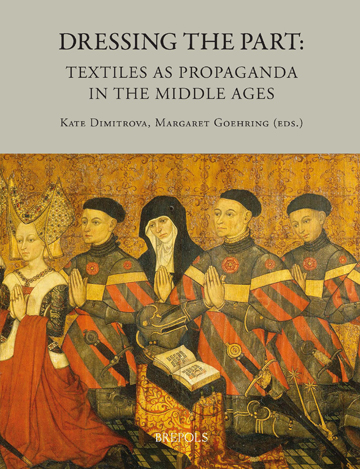
Hardback (Out of print)
(May 2015)
ISBN: 9782503536767
8.27 x 10.83 inches
Price: $150.00
In stock
This volume explores the ways in which textiles were used or invoked in the construction and display of power in the Middle Ages.
During the Middle Ages, textiles played a particularly prominent role in the communication of wealth and authority by mediating the body politic and defining spaces of political, religious, and social power. The intrinsic material value of textiles-which could be woven out of silk, enriched with silver and gold threads, and garnished with precious stones-complemented an elaborate visual language that conveyed ideological messages. From the ornamented sphere of ecclesiastical dress and the celebrations of feast days to an aristocrat’s various rites of passage (such as birth, marriage, coronation, and death), textiles functioned as propaganda. Rulers across the European, Byzantine and Islamic worlds expressed their dynastic claims, military prowess, political aspirations and accomplishments by commissioning, displaying, wearing, and offering textiles. Because textiles are portable, wearable and displayable their performative qualities result in multivalent meanings that medieval patrons exploited. In essence, the meaning of textiles can never truly be fixed. Textiles inherently represent a confluence of messages because they operate within multiple systems of signs-costume, liturgical display, ceremonies of state, funerary ritual, memorial display and personal or corporate identity to name a few. While contemporary historians might label this multivalency as Lacanian, in fact, perhaps more than any other art form, textiles amplify and even reveal the medieval appreciation for the inherent flexibility of signs. This volume explores the ways in which textiles were used or invoked in the construction and display of power. The essays include material culture studies that explore textile display, archival investigations that reveal patterns of donation, technical studies concerning design and production processes, as well as art historical studies concerning the representation of textiles in other media. All together, these essays offer insight into how textiles were interwoven with notions of identity, status, and power during the Middle Ages.
- Edited by K. Dimitrova
- Edited by Margaret Goehring
Similar Books
 «Solazoxa festa, stradolze e stracomplia»
Festschrift für Raymund Wilhelm zum 65. Geburtstag mit Beiträgen zu Diskurstraditionen und mittelalterlicher Philologie
Volume 249
 A Collaborative Tapestry in Honour of Shirley Ann Brown / Une fresque brodée en l’honneur de Shirley Ann Brown
The Bayeux Tapestry Seen by her Colleagues and Friends / La Tapisserie de Bayeux vue par ses collègues et amis




 Balthasar Caymox of Nuremberg
Early Modern German Print Publishers: Popular Prints of the Seventeenth Century
 Behind the Scenes of Medieval Roofs
An Overview of the Roofing Systems of Italian Churches
Volume 90


 Cahiers de recherches médiévales et humanistes – Journal of Medieval and Humanistic Studies
Volume 51





 ENTANGLED AFRICA
Intra-African Relations Between Rain Forest and Mediterranean from Around 4,000 BCE to 1,500 CE



 Gold, Silver and Glass: Power Networks, Cultural Identities, Technology Transfers and Agency across the Old World (7th Century BC – 1st Century AD)
Proceedings of a Conference Held at the British Museum, 16–18 June 2023


 Innovation and Medieval Communities
The Circulation of Ideas and Practices in and out of the Town (1200-1500)
Volume 63
 John Dunstaple Reading Boethius
John Dunstaple’s Annotations to Boethius’s “De institutione musica” in the Manuscript Oxford, Corpus Christi College Library, MS 118
 Legal Visuality
Exegesis, Ambiguity, and Dissimulation of the Donation of Constantine in the Early Modern Period
 Listening to the Swan Song
More-than-Human Beings and Sounds in Literature and Culture Through the Ages


 Medieval Debates on Foreknowledge: Future Contingents, Prophecy, and Divination
Acts of the XXVII Annual Colloquium of the SIEPM, Trento 12-15 September 2023
Volume 31