
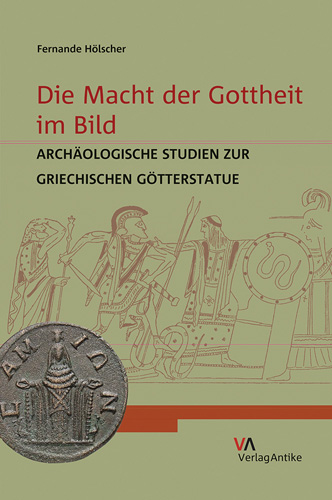
Die Macht der Gottheit im Bild
Archäologische Studien zur griechischen Götterstatue
By (author) Fernande Hölscher
Hardback (Published)
(December 2017)
ISBN: 9783946317159
6.1 x 8.9 inches
Price: $138.00
In stock
Diese Zusammenschau der Kultbilder vom 8. bis zum 4. Jahrhundert v. Chr. erschliesst mehrere Riten und Mythen um griechische Kultbilder neu.
Im antiken Griechenland suchten die Menschen, der Gottheit im dinglichen Gegenuber zu begegnen. Seit fruher Zeit gab es Orte, die als Erinnerungsstutzen fur die Prasenz der Gotter dienten, die halfen, die Gotter, wie sie vor allem durch Homer und Hesiod vermittelt waren, zu imaginieren. Dem gegenuber wurde mit Kultbildern in groaerem Format seit dem 8./7. Jahrhundert v. Chr. eine neue Qualitat erreicht: Die Gotter standen nun leibhaftig vor den Augen der Verehrenden, die sie wie ihresgleichen pflegten, an andere Orte brachten, mit Dank und Bitten in ihr personliches Leben einbezogen. Die Nahe, die sich in Gestalt der Gotterstatuen als “Personen” auftat, war spateren rationalen Kritikern suspekt, welche die Materialhaftigkeit der Bilder in den Vordergrund stellten und damit die “lebendige” Macht der Gotterbilder leugneten. Die These dieser Zusammenschau der Kultbilder vom 8. bis zum 4. Jahrhundert v. Chr. ist jedoch, dass man durchweg Strategien entwickelte, diese Materialitat in Ritualen und Geschichten zu uberspielen, weil man das lebendig erfahrene Bild zum nahen Umgang mit der Gottheit brauchte. Von der Macht der Gottheit im Bild aus erschlieaen sich mehrere Riten und Mythen um griechische Kultbilder neu.
Fernande Holscher ist klassische Archaologin und lebt in Heidelberg.
- By (author) Fernande Hölscher
"In this voluminous study, Fernande Holscher discusses Greek cult statues from the earliest examples in the 8th and 7th centuries with a preliminary paragraph on possible Minoan and Mycenaean examplesdown to the 5th century BC, with a coda on the 4th. . . .one might say that we get two books for the price of one, in which the first seven chapters lay the groundwork for the last five. But they do so at such length that they could easily stand on their own. . . .This is an important and interesting study, not just for classical archaeologists, as the subtitle seems to imply, but also for those interested in the religion(s) of the ancient world, even if there is no easy access to its riches." Frederick G. Naerebout, Bryn Mawr Classical Review, 2019.06.11.
—
Similar Books


 Caesar’s Visions and Impact on the Roman Empire
Revisiting the Archaeological and Historical Record of the 40s BC
Volume 2


 Construction Processes in Historical Western Societies (5th c. BC – 10th c. AD)
Case Studies on Techniques, Models, and Costs
 Contesting Labeled Identities
The Sociology of Gentilics in Biblical and Northwest Semitic Literature

 Drunk the Potion, No Whit Charmed
The Doctrine of Pure and Perfect Souls from Iamblichus to Damascius

 Epigraphic “Shades” from Hellenistic Thrace
Contextualizing Inscriptions in Greek from Thracian Tombs

 Epiphanies of the Divine in the Septuagint and the New Testament
Fifth International Symposium of the Corpus Judaeo-Hellenisticum Novi Testamenti (CJHNT), 14-17 May 2015, Nottingham


 Etruscan and Roman Hellenistic Anatomical ex votos
Reassessing Popular Religious Expressions in Central Italy
Volume 8



 Gold, Silver and Glass: Power Networks, Cultural Identities, Technology Transfers and Agency across the Old World (7th Century BC – 1st Century AD)
Proceedings of a Conference Held at the British Museum, 16–18 June 2023


 Invisible Labour in Antiquity
Visualizing Obscure Work in the Ancient Mediterannean and West Asia
Volume 1

 Language and Power in the Roman Empire and Early India
Hierarchy, Ambiguity, and the Art of Reading the Signs in Cosmopolitan Cultures
 Late Antique villae in the Balkans (3rd–7th c. AD): Current Research Questions and Perspectives
HAEMUS Companion to the Late Antique Balkans 1
Volume 4





 Nurturing the Elite
Representations of Drinking, Eating, and Religious Vessels in Palmyrene Funerary Iconography
Volume 13


 Portraying the Individual in the Roman East
Local–Imperial Entanglements in Sculpture, Mosaics, and Paintings (First–Fourth Centuries AD)
Volume 18
