
Collection of Ancient Chinese Cultural Relics, Volume 10
translated by Wang Guozhen
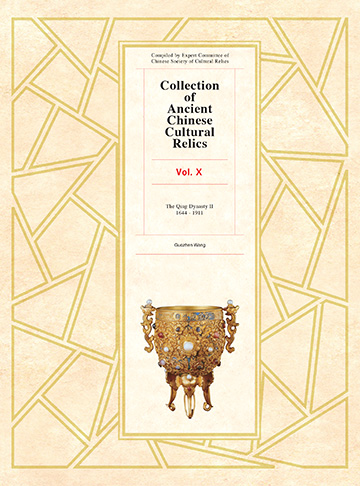
The second volume dealing with ancient Chines cultural relics in the Qing Dynasty, 1644 to 1911. There are 375 relics. A continuation of Volume 9, dealing with the Qing Dynasty and describes paintings, calligraphy, embroidery and brocade, gold and silver ware and metal enamel ware and clocks. Paintings in this period can be divided into the early, middle and late stages. Early stage: Four Wangs painting school: Wang Shimin, Wang Jian, Wang Hui and Wang Yuanqi. Midle stage: representative artists include: Jiao Bingzhenb, Leng Mei, Tang Dai during Kangxi’s reign,and Ding Guanpeng, Jin Tingbiao, Xu Yang, Zhang Zongcang, Jian Tingxi and Zou Yigui in Qianlong’s reign. Late stage paintings of literati gradually declined. When the newly developed business cities such as Shanghai and Guangzhou, opened as trading ports, changes were made in themes and styles. New schools formed: ‘Secoast School’ in Shanghai and ‘Ling,an School’ in Guangzhou. The former group artists included: Xu Gu, Zhao Zhiqian, Wu Changshuo, while the other school included: Su Liupeng, Su Ren Sahn, Ju Chao and Ju Lian. This book, the tenth in a ten-volume collection, brings to the English-speaking world a series of books from China which has been complied by an Expert Committee of the Chinese Society of Cultural Relics. There are 375 descriptions.
The second volume dealing with ancient Chines cultural relics in the Qing Dynasty, 1644 to 1911. There are 375 relics. A continuation of Volume 9, dealing with the Qing Dynasty and describes paintings, calligraphy, embroidery and brocade, gold and silver ware and metal enamel ware and clocks. Paintings in this period can be divided into the early, middle and late stages. Early stage: Four Wangs painting school: Wang Shimin, Wang Jian, Wang Hui and Wang Yuanqi. Midle stage: representative artists include: Jiao Bingzhenb, Leng Mei, Tang Dai during Kangxi’s reign,and Ding Guanpeng, Jin Tingbiao, Xu Yang, Zhang Zongcang, Jian Tingxi and Zou Yigui in Qianlong’s reign. Late stage paintings of literati gradually declined. When the newly developed business cities such as Shanghai and Guangzhou, opened as trading ports, changes were made in themes and styles. New schools formed: ‘Secoast School’ in Shanghai and ‘Ling,an School’ in Guangzhou. The former group artists included: Xu Gu, Zhao Zhiqian, Wu Changshuo, while the other school included: Su Liupeng, Su Ren Sahn, Ju Chao and Ju Lian. This book, the tenth in a ten-volume collection, brings to the English-speaking world a series of books from China which has been complied by an Expert Committee of the Chinese Society of Cultural Relics. There are 375 descriptions.
- By (author) ATF Press
- Translated by Wang Guozhen
Similar Books
 A Collaborative Tapestry in Honour of Shirley Ann Brown / Une fresque brodée en l’honneur de Shirley Ann Brown
The Bayeux Tapestry Seen by her Colleagues and Friends / La Tapisserie de Bayeux vue par ses collègues et amis




 Balthasar Caymox of Nuremberg
Early Modern German Print Publishers: Popular Prints of the Seventeenth Century

 Between Bones and Beliefs
Human-Bird Relations in Central and Northern Europe in the First Millennium AD
Volume 4


 Christina of Sweden in Context
A Celebration of Seventeenth-Century Queenship 400 Years in the Making


 Engaged Languages and Literatures / Langues et Littératures engagées
Critical Views / Regards Critiques
 ENTANGLED AFRICA
Intra-African Relations Between Rain Forest and Mediterranean from Around 4,000 BCE to 1,500 CE




 Gold, Silver and Glass: Power Networks, Cultural Identities, Technology Transfers and Agency across the Old World (7th Century BC – 1st Century AD)
Proceedings of a Conference Held at the British Museum, 16–18 June 2023


 Legal Visuality
Exegesis, Ambiguity, and Dissimulation of the Donation of Constantine in the Early Modern Period
 Listening to the Swan Song
More-than-Human Beings and Sounds in Literature and Culture Through the Ages


 Monastic Manuscripts from the Eastern Mediterranean (Sinai, Jerusalem, Antioch)
Production, Use, and Contexts

 Naples as Laboratory / Laboratorium Neapel
Style Options, Artistic Rivalry and Self Fashioning in Neapolitan Baroque Painting / Plurale Stilbildung, Kunstlerkonkurrenz und Self Fashioning in der neapolitanischen Barockmalerei

 Nurturing the Elite
Representations of Drinking, Eating, and Religious Vessels in Palmyrene Funerary Iconography
Volume 13


