The Claustrum
An Investigation of Claustrophobic Phenomena
By (author) Donald Meltzer
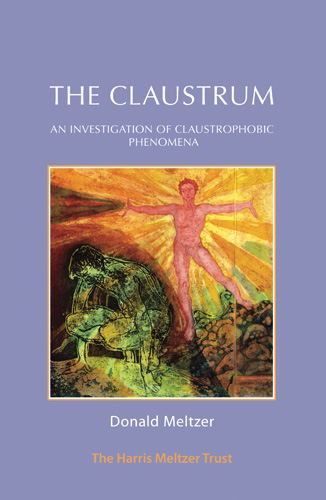
Paperback (Published)
(July 2018)
ISBN: 9781912567270
5.94 x 9.09 inches
Price: $40.00
In stock
Using the Kleinian concept of projective-identification, with special reference to intrusive identification with internal objects, this work examines claustrophobic phenomena and its relations to the treatment of borderline and adolescent patients.
Foreword Meg Harris Williams PART ONE: BACKGROUND AND INTRODUCTION Introduction 1. Melanie Klein's vision of projective identification 2. Review of earlier publications PART TWO: COMPARTMENTS OF THE CLAUSTRUM 3. The geographic dimension of the mental apparatus 4. The compartments of the internal mother 5. Life in the Claustrum 6. Technical problems of the Claustrum PART THREE: IMPLICATIONS OF THE CLAUSTRUM 7. Emergence from the Claustrum versus shift of consciousness 8. The role of the Claustrum in the onset of schizophrenia 9. Concerning the ubiquity of projective identification 10. Symptomatology versus characterology - the psychoanalytical process 11. The Claustrum and adolescence 12. The Claustrum and the perversions/addictions 13. The Claustrum and politics Addendum - Macbeth's equivocation, Shakespeare's ambiguity Meg Harris Williams References Index,
Foreword
Meg Harris Williams
PART ONE: BACKGROUND AND INTRODUCTION
Introduction
1. Melanie Klein’s vision of projective identification
2. Review of earlier publications
PART TWO: COMPARTMENTS OF THE CLAUSTRUM
3. The geographic dimension of the mental apparatus
4. The compartments of the internal mother
5. Life in the Claustrum
6. Technical problems of the Claustrum
PART THREE: IMPLICATIONS OF THE CLAUSTRUM
7. Emergence from the Claustrum versus shift of consciousness
8. The role of the Claustrum in the onset of schizophrenia
9. Concerning the ubiquity of projective identification
10. Symptomatology versus characterology – the psychoanalytical process
11. The Claustrum and adolescence
12. The Claustrum and the perversions/addictions
13. The Claustrum and politics
Addendum – Macbeth’s equivocation, Shakespeare’s ambiguity
Meg Harris Williams
References
Index
Donald Meltzer (1923–2004) was born in New York and studied medicine at Yale. After practising as a psychiatrist specialising in children and families, he moved to England to have analysis with Melanie Klein in the 1950s, and for some years was a training analyst with the British Society. He worked with both adults and children, and was innovative in the treatment of autistic children; in the treatment of children he worked closely with Esther Bick and Martha Harris whom he later married. He taught child psychiatry and psychoanalytic history at the Tavistock Clinic. He also took a special scholarly interest in art and aesthetics, based on a lifelong love of art. Meltzer taught widely and regularly in many countries, in Europe, Scandinavia, and North and South America, and his books have been published in many languages and continue to be increasingly influential in the teaching of psychoanalysis.
His first book, The Psychoanalytical Process, was published by Heinemann in 1967 and was received with some suspicion (like all his books) by the psychoanalytic establishment. Subsequent books were published by Clunie Press for the Roland Harris Educational Trust which he set up together with Martha Harris (now the Harris Meltzer Trust). The Process was followed by Sexual States of Mind in 1973, Explorations in Autism in 1975; The Kleinian Development in 1978 (his lectures on Freud, Klein and Bion given to students at the Tavistock); Dream Life in 1984; The Apprehension of Beauty in 1988 (with Meg Harris Williams); and The Claustrum in 1992.
- By (author) Donald Meltzer
Similar Books
 Attics and Basements
The Evocative, Expressive and Embracing Functions of Homes and Other Human Dwellings




















 Die Erhebung und Bewertung von Zeugenaussagen im Strafprozess
Juristische, aussagepsychologische und psychiatrische Aspekte. Bd. 9






 Kann man Filterblasen platzen lassen?
101 Fragen und Antworten rund um Verschwörungstheorien, Fake News und ideologische Überzeugungen