The Story of Infant Development

By (author) Romana Negri By (author) Martha Harris

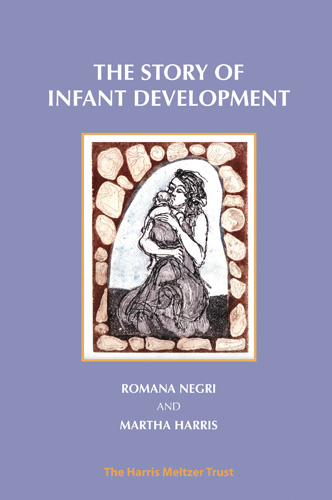
Book cover: The Story of Infant Development

Extent: 260 pages

Publisher: The Harris Meltzer Trust

Subjects: Psychology, Psychoanalysis, & Psychotherapy

Language: English

Paperback (Published)

(April 2018)

ISBN: 9781912567096

5.94 x 9.09 inches

Price: $42.00

In stock

PDF (Published)

(April 2018)

ISBN: 9781912567119

Price: $42.00

The Story of Infant Development’ details Romana Negri’s close observation of a child (Simone) from birth to age three, accompanied by perceptive comments from her supervisor Martha Harris, who developed Observational Studies at the Tavistock Clinic.


This book brings together the closely observed development of Simone (from birth to three) and the perceptive comments of Martha (or Mattie) Harris, who was such an influential figure in the development of the Observational Studies Course at the Tavistock. Romana Negri’s pioneering work on neonatal intensive care units is informed both by infant observation and by psychoanalysis. She presents in this volume the transcribed tapes of her detailed observation of a normally developing infant, whom Martha Harris supervised for three years. Other chapters present observations of children in hospital that formed part of their diagnostic assessment, and the book includes commentaries by Donald Meltzer and Martha Harris together. This book will be of outstanding interest to all readers whether parents, teachers, or mental health professionals who wish to deepen their understanding of the roots of mental life.

Editorial Note Meg Harris Williams Preface Gianna Polacco Williams Introduction Romana Negri CHAPTER ONE The pattern of normal development: forming a relationship with the breast A stunning experience A state of normal non-integration and evacuation of sensations The pull of the nipple Maternal depression and the difficulty of introjecting the object Digesting emotions Problems of identification in the mother The breast that comes and goes away The bottle, and a distance from the mother CHAPTER TWO The pattern of normal development: the end of breastfeeding The end of breastfeeding Feelings of aggression and seduction Representations of the breast The lost breast and the nipple lifeline Mother returns to work-the new sweetheart The only baby The relationship with the father How the new baby is made The little chair-the new place in the family CHAPTER THREE The story of the birth of the next sibling Feminine and masculine qualities The value of fairy tales The epistemophilic instinct One day it will be his turn A point of "catastrophic change" Birth of the next sibling The "imbecile" infantile self that damages its objects The second day at nursery school (with Donald Meltzer) The third birthday CHAPTER FOUR A three-year-old uses the gang as container Summary of the first two observation sessions The gang and circularity of time The parents' unfulfilled childhood (with Donald Meltzer) CHAPTER FIVE Play observation in a hospital setting: some diagnostic implications Eleanora: redefining a diagnosis of child psychosis as neurotic anxiety Daniela: redefining a diagnosis of epilepsy as psychosomatic illness Vittoria: redefining a diagnosis of brain pathology in terms of mental insufficiency Infant observation: Matteo (early internalization of the object) Infant observation: Giuseppino (the relation of the child's way of looking to the mother's emotional condition) Index,

Editorial Note
Meg Harris Williams

Preface
Gianna Polacco Williams

Introduction
Romana Negri

CHAPTER ONE
The pattern of normal development: forming a relationship with the breast

A stunning experience
A state of normal non-integration and evacuation of sensations
The pull of the nipple
Maternal depression and the difficulty of introjecting the object
Digesting emotions
Problems of identification in the mother
The breast that comes and goes away
The bottle, and a distance from the mother

CHAPTER TWO
The pattern of normal development: the end of breastfeeding
The end of breastfeeding
Feelings of aggression and seduction
Representations of the breast
The lost breast and the nipple lifeline
Mother returns to work—the new sweetheart
The only baby
The relationship with the father
How the new baby is made
The little chair—the new place in the family

CHAPTER THREE
The story of the birth of the next sibling
Feminine and masculine qualities
The value of fairy tales
The epistemophilic instinct
One day it will be his turn
A point of “catastrophic change”
Birth of the next sibling
The “imbecile” infantile self that damages its objects
The second day at nursery school (with Donald Meltzer)
The third birthday

CHAPTER FOUR
A three-year-old uses the gang as container

Summary of the first two observation sessions
The gang and circularity of time
The parents’ unfulfilled childhood (with Donald Meltzer)

CHAPTER FIVE
Play observation in a hospital setting: some diagnostic implications
Eleanora: redefining a diagnosis of child psychosis as neurotic anxiety
Daniela: redefining a diagnosis of epilepsy as psychosomatic illness
Vittoria: redefining a diagnosis of brain pathology in terms of mental insufficiency
Infant observation: Matteo (early internalization of the object)
Infant observation: Giuseppino (the relation of the child’s way of looking to the mother’s emotional condition)

Index

 

Romana Negri graduated in medicine and trained as a child neuropsychiatrist at the University of Milan. From 1970 onwards she attended the seminars of Martha Harris and Donald Meltzer and commenced work projects inspired and influenced by their teaching. From 1976 to 2004 she was a consultant in the Special Care Baby Unit at the Caravaggio Hospital, Treviglio, publishing some of her research findings in The Newborn in the Intensive Care Unit. Since 1982 she has been a professor at Milan University, teaching in the paediatric department of the School of Medicine and the School of Psychiatry and Psychology. She is also responsible for early pathology consultation at the Sacco Hospital in Milan. She has published over one hundred papers in the field of early psychopathology and child psychiatry in Italy, Germany, France, Spain, and England.

Martha Harris (1919–1987) read English at University College London and then Psychology at Oxford. She taught in a Froebel Teacher Training College and was trained as a Psychologist at Guys Hospital, as a Child Psychotherapist at the Tavistock Clinic, where she was for many years responsible for the child psychotherapy training in the department of Children and Families, and as a Psychoanalyst at the British Institute of Psychoanalysis. Together with her first husband Roland Harris (a teacher) she started a pioneering schools counselling service. With her second husband Donald Meltzer she wrote a psychoanalytical model of The Child in the Family in the Community for multidisciplinary use in schools and therapeutic units.

  • By (author) Romana Negri
  • By (author) Martha Harris