
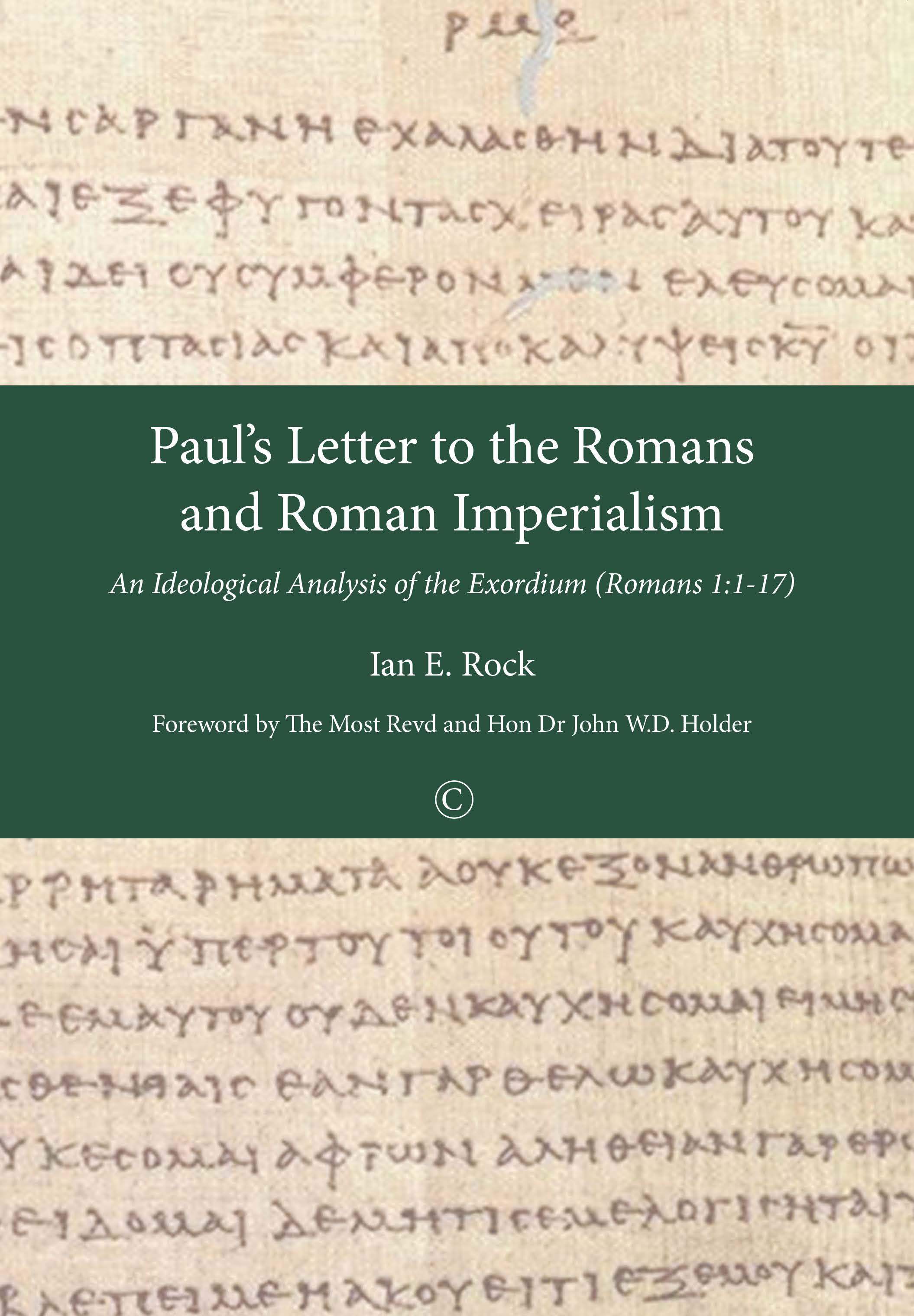
Paul’s Letter to the Romans and Roman Imperialism
An Ideological Analysis of the Exordium (Romans 1:1-17)
by Ian E. Rock
Paperback (No longer our product)
(May 2017)
ISBN: 9780227176450
7.01 x 10 inches
Price: $58.00
In stock
A new reading of First Romans as an anti-imperial missive, revealing the complex interplay between theology and ideology.
Ian E. Rock demonstrates that the Letter to the Romans may be seen as an attempt by a subordinate group to redress actual and potential issues of confrontation with the Empire and to offer hope, even in the face of death. Paul demonstrates that it is God’s peace and not Rome’s peace that is important; that loyalty to the exalted Jesus as Lord and to the kingdom of God – not Jupiter and Rome – leads to salvation; that grace flows from Jesus as Christ and Lord and not from the benefactions of theEmperor. If the resurrection of Jesus – the crucified criminal of the Roman Empire – demonstrates God’s power over the universe and death, the very instrument of Roman control, then the Christ-believer is encouraged to face suffering and death in the hope of salvation through this power. Paul’s theology emerges from, and is inextricably bound to, the politics of his day, the Scriptures of his people, and to the critical fact that the God who is One and Lord of all is still in charge of the world.
- By (author) Ian E Rock
A model of what exegesis must be in a global, postmodern world. Ian Rock's remarkable study of Romans 1:1-17 (and 9-11) makes explicit its analytical/textual frame (a rigorous historical critical/political and rhetorical exegesis), its contextual frame (Rock's experience of the interaction of imperialism and religion in the Caribbean and in Rome), and its hermeneutical/ideological frame (striking theological insights in Paul's letter).-Dr Daniel Patte, Professor of Religious Studies, New Testament and Early Christianity, Vanderbilt UniversityBy means of an ideological analysis of the exordium (Rom1:1-17), Ian Rock demonstrates that the issues between Jew and Gentile arising from the arrival of the Christ-movement in first-century Rome concerned more than intercommunal conflicts. ... Rock offers a challenging reinterpretation of Romans that combines careful exegesis, theological and ideological competence, and a concern for context aided by his own Caribbean insights - an excellent study that uses a close analysis of the exordium to support the unity and integrity of the letter.-Dr William S. Campbell, Reader in Biblical Studies in the School of Theology, Religious Studies and Islamic Studies, University of Wales, Trinity Saint DavidThis is a stimulating in-depth analysis of the opening passage of Romans that triggers a wave of insights into the whole letter. Its hermeneutical rigor in the conscious location of thought both in the twenty-first-century Caribbean world as well as in the first-century Roman-dominated world offers a political reading of Romans that will lead to important further discussion in the academy and beyond.-Dr Kathy Ehrensperger, Reader in New Testament Studies in the School of Theology, Religious Studies and Islamic Studies, University of Wales, Trinity Saint David
—
Similar Books




 Cyril of Alexandria’s Christological Exegesis
Explorations of Partitive Exegesis in the Dialogues on the Trinity
Volume 70


 Extracanonical Traditions and the Holy Land
Texts, Rituals, and Material Culture in Late Antique Palestine
 From Joseph to Jesus
The Joseph Narrative as a Compositional Template from Old Greek Esther to the Gospel of Luke
Volume 125


 Nicholas of Lyra’s Commentaries on the Gospels of Matthew and Luke
Franciscan Exegesis in a Time of Crisis

 Punning in Odd or Elegant Constructions in Jeremiah
The Convergence of Linguistics, Rhetoric, and Textuality in the Hebrew Text of Jeremiah


 Reformed Covenantal Eudaimonism
Wilhelmus à Brakel (1635–1711) on Highest Good, Virtue, and Law
Volume 87


 The Biblical Tale of Judah and Tamar in Fourteenth-Century Iran
A Judeo-Persian Versified Account by Shāhīn with Scholarly Edition, Annotated Translation and Persian Transliteration
Volume 94, 951
 The Body
Lived, Cultured, Adorned: Essays on Dress and the Body in the Bible and Ancient Near East in Honor of Nili S. Fox






 The Therapeutae as the Best Paradigm for the Contemplative Life
A Contextual Reading of Philo of Alexandria's De Vita Contemplativa

