Freud in Istanbul
Turkish Contributions to Psychotherapy and Psychoanalysis
Edited by Salman Akhtar
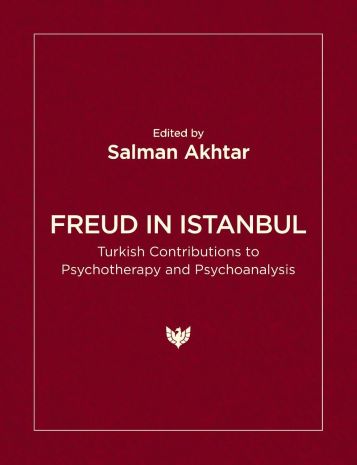
Paperback (Published)
(October 2025)
ISBN: 9781800133204
7.4 x 9.72 inches
Price: $63.00
In stock
A vital book that seeks to place Turkish contributions to psychoanalytic theory and practice on the international stage from which, until now, it has been curiously absent. It includes chapters from those living and working in Turkey and from those representing the Turkish diaspora, and from both established and emerging leaders in
With contributions from Salman Akhtar, Muge Alkan, Gulgun Alptekin, Mine Ozguroglu Cukurcesme, Yavuz Erten, Cemile Serin Gurdal, Elif Nisan Ilkmen, Ulku Elif Gurisik, Bella Habip, Cuneyt Iscan, Sureyya Iscan, T. Byram Karasu, M. Sagman Kayatekin, Z. Emel Kayatekin, Pinar Limnili Ozeren, Talat Parman, Kutlughan Soyubol, Duygu Tekgul-Akin, Isil Vahip, Vamik D. Volkan, and Ayla Yazici. The book is divided into four parts. The first looks at the history of psychoanalysis in Turkey. The second investigates the psychology of mothers, fathers, siblings, and the adolescent phase in Turkey. The third addresses the complexities and nuances of identity formation, nostalgic rumination, massive trauma, and female aggression in the context of Turkish society at large, including the use of film and literature. The fourth pertains to technical clinical issues, dealing with matters as diverse as grief, spirituality in the context of psychotherapy and psychoanalysis, tenacious maternal transferences and the handling of nonverbal material in the clinical session, to name but a few. While the book is psychoanalytic, not all contributors are analysts; many belong to other fields including psychology, sociology, psychiatry, and cultural anthropology. Thus, this is a book not only for psychoanalysts, but also for members of those fields, psychotherapists, and anyone with an interest in Turkish culture.
Acknowledgements About the editor and contributors Introduction Part I: Historical backdrop 1. Turkey psychoanalyzed and psychoanalysis Turkified Kutlughan Soyubol 2. Crosscurrents between the development of psychoanalysis and self-psychology in Turkey Yavuz Erten 3. Psychoanalysis, Turkey, and the IPA Vamik D. Volkan Part II: Developmental observations 4. The nuances of mother-daughter relationship in Turkish culture Muge Alkan and Salman Akhtar 5. Fatherhood and Turkish culture Cuneyt Iscan and Sureyya Iscan 6. Sibling relationship and some thoughts on siblings in Turkish culture Pinar Limnili Ozeren 7. The absence of adolescent-like traits in the adult psyche Talat Parman Part III: Cultural studies 8. The multilayered archeology of Turkish identity M. Sagman Kayatekin and Z. Emel Kayatekin 9. An exploration of hysteria through the Turkish movie Nefret (1984) Elif Nisan Ilkmen 10. Fact, fiction and value in Orhan Pamuk's Museum of Innocence (2008) Duygu Tekgul-Akin 11. Suffering and memory of Holocaust survivors in Eytan Ipeker's The Pageant (2020) Bella Habip Part IV: Clinical reports 12. Incest and the role of silent mothers Ulku Elif Gurisik 13. Art as a way of coping with the psychotic self Ayla Yazici 14. Sounds, smells, and sundry amorphous material in the clinical hour Cemile Serin Gurdal 15. Transforming the 'enslaving mother' image to 'liberating mother' image through the 'analyst's womb' in transference Gulgun Alptekin 16. Technical challenges with bereavement in the course of an ongoing analysis Isil Vahip 17. Spiritual elements in psychotherapy and psychoanalysis T. Byram Karasu 18. Some thoughts on tele-analysis in Turkey Mine Ozguroglu Cukurcesme References Index,
Contents
Acknowledgements
About the editor and contributors
Introduction
Part I: Historical backdrop
1. Turkey psychoanalyzed and psychoanalysis Turkified
Kutluğhan Soyubol
2. Crosscurrents between the development of psychoanalysis and self-psychology in Turkey
Yavuz Erten
3. Psychoanalysis, Turkey, and the IPA
Vamık D. Volkan
Part II: Developmental observations
4. The nuances of mother–daughter relationship in Turkish culture
Müge Alkan and Salman Akhtar
5. Fatherhood and Turkish culture
Cüneyt İşcan and Süreyya İşcan
6. Sibling relationship and some thoughts on siblings in Turkish culture
Pınar Limnili Özeren
7. The absence of adolescent-like traits in the adult psyche
Talat Parman
Part III: Cultural studies
8. The multilayered archeology of Turkish identity
M. Sağman Kayatekin and Z. Emel Kayatekin
9. An exploration of hysteria through the Turkish movie Nefret (1984)
Elif Nisan İlkmen
10. Suffering and memory of Holocaust survivors in Eytan İpeker’s The Pageant (2020)
Bella Habip
Part IV: Clinical reports
11. Incest and the role of silent mothers
Ülkü Elif Gürışık
12. Art as a way of coping with the psychotic self
Ayla Yazıcı
13. Sounds, smells, and sundry amorphous material in the clinical hour
Cemile Serin Gürdal
14. Transforming the ‘enslaving mother’ image to ‘liberating mother’ image through the 'analyst’s womb’ in transference
Gülgün Alptekin
15. Technical challenges with bereavement in the course of an ongoing analysis
Işıl Vahip
16. Spiritual elements in psychotherapy and psychoanalysis
T. Byram Karasu
17. Some thoughts on tele-analysis in Turkey
Mine Özgüroğlu Çukurçeşme
References
Index
Salman Akhtar, MD, is Professor of Psychiatry at Jefferson Medical College and a Training and Supervising Analyst at the Psychoanalytic Center of Philadelphia. He has served on the editorial boards of the International Journal of Psychoanalysis, the Journal of the American Psychoanalytic Association, and the Psychoanalytic Quarterly. His more than 400 publications include 105 books, of which the following 22 are solo-authored: Broken Structures (1992), Quest for Answers (1995), Inner Torment (1999), Immigration and Identity (1999), New Clinical Realms (2003), Objects of Our Desire (2005), Regarding Others (2007), Turning Points in Dynamic Psychotherapy (2009), The Damaged Core (2009), Comprehensive Dictionary of Psychoanalysis (2009), Immigration and Acculturation (2011), Matters of Life and Death (2011), The Book of Emotions (2012), Psychoanalytic Listening (2013), Good Stuff (2013), Sources of Suffering (2014), No Holds Barred (2016), A Web of Sorrow (2017), Mind, Culture, and Global Unrest (2018), Silent Virtues (2019), Tales of Transformation (2021), and In Leaps and Bounds (2022).
Dr Akhtar has delivered many prestigious invited lectures including a Plenary Address at the 2nd International Congress of the International Society for the Study of Personality Disorders in Oslo, Norway (1991), an Invited Plenary Paper at the 2nd International Margaret S. Mahler Symposium in Cologne, Germany (1993), an Invited Plenary Paper at the Rencontre Franco-Americaine de Psychanalyse meeting in Paris, France (1994), a Keynote Address at the 43rd IPA Congress in Rio de Janiero, Brazil (2005), the Plenary Address at the 150th Freud Birthday Celebration sponsored by the Dutch Psychoanalytic Society and the Embassy of Austria in Leiden, Holland (2006), the Inaugural Address at the first IPA-Asia Congress in Beijing, China (2010), and the Plenary Address at the Fall Meetings of the American Psychoanalytic Association in 2017.
Dr Akhtar is the recipient of numerous awards including the American Psychoanalytic Association’s Edith Sabshin Award (2000), Columbia University’s Robert Liebert Award for Distinguished Contributions to Applied Psychoanalysis (2004), the American Psychiatric Association’s Kun Po Soo Award (2004) and Irma Bland Award for being the Outstanding Teacher of Psychiatric Residents in the country (2005). He received the highly prestigious Sigourney Award (2012) for distinguished contributions to psychoanalysis. In 2103, he gave the Commencement Address at graduation ceremonies of the Smith College School of Social Work in Northampton, MA.
Dr Akhtar’s books have been translated in many languages, including German, Italian, Korean, Romanian, Serbian, Spanish, and Turkish. A true Renaissance man, Dr Akhtar has served as the Film Review Editor for the International Journal of Psychoanalysis, and is currently serving as the Book Review Editor for the International Journal of Applied Psychoanalytic Studies. He has published 11 collections of poetry and serves as a Scholar-in-Residence at the Inter-Act Theatre Company in Philadelphia. His Selected Papers (Volumes I-X) were recently published and released at a festive event held at the Freud Museum London.
- Edited by Salman Akhtar
‘Professor Akhtar’s masterfully edited text explores the intricate relationship between “inner and outer” psychological spheres within a Turkish cultural context. Drawing from multiple disciplines and a broad psychoanalytic frame, the authors explore poignant themes, such as motherhood, fatherhood, siblings, spirituality, and the arts, skilfully illustrating the rich nuances of identity. This is a most original contribution which will enrich the cross-cultural psychotherapy field and anthropological psychoanalysis.’
— Zack Eleftheriadou, MA, MSc, Psychoanalytic Psychotherapist, British Psychotherapy Foundation, London, Author of 'Psychotherapy and Culture: Weaving Inner and Outer Worlds'
‘Turkey’s palimpsestic history is an apt metaphor for the psychoanalytic model of the mind. And who better than Salman Akhtar to put it together with his sweeping knowledge and his formidable comprehensiveness? This edited volume covers everything from cultural to developmental and contemporary issues. It introduces us to the elusive and fascinating encounter between two equally intriguing bedfellows: Turkey and Psychoanalysis.’
— Nilofer Kaul, PhD, Training and Supervising Analyst, New Delhi, Author of 'Plato’s Ghost: Minus Links and Liminality in Psychoanalytic Practice'
‘As someone deeply invested in the global discourse of psychoanalysis, I find Freud in Istanbul: Turkish Contributions to Psychotherapy and Psychoanalysis to be a truly special and enriching volume. Salman Akhtar has curated a collection that goes beyond mere academic inquiry, offering profound insights into how psychoanalytic thought beautifully intertwines with the unique cultural tapestry of Turkey.’
— Michael Shoshani, PsyD, MBA, Training and Supervising Analyst, Institute for Contemporary Psychoanalysis, Tel Aviv, Coauthor of 'Timeless Grandiosity and Eroticised Contempt'
‘Turkey, where East meets West, never disappoints when it comes to synthesizing eastern and western culture in its melting pot. Neither does this book. The reader will be pleasantly surprised, moved, and will fall in love with the Turkish culture and with psychoanalysis – in the ability of both to thrive against all odds.’
— Sumru Tüfekçioğlu, PhD, Director of Clinical Education, William Alanson White Institute, New York, Executive Editor of 'Contemporary Psychoanalysis'
Similar Books
 Attics and Basements
The Evocative, Expressive and Embracing Functions of Homes and Other Human Dwellings



 Cities through Time
Glimpses into Urbanity and Community in Mediaeval to Modern West Asia and Egypt
Volume 1

 Cuneiform Artefacts from Archaeological Contexts: New Research on Ancient Iraq
Proceedings of a Conference Held at the Bavarian Academy of Sciences and Humanities, July 4–5, 2024
Volume 2




 From the Frontiers of the Empire to the Borders of the Nations
Borderland Security and Safety in the (post-)Ottoman Spaces (1700–1939)
 Global Gulf
Geo-Economic, Geo-Political, and Geo-Technological Transformation in Saudi Arabia, the United Arab Emirates, and Qatar



 Islamic Rituals Beyond the Mosque
Historical Evolution of Prayer and Devotion in Physical Space and Cyberspace
 Ismail Hakki Bursevi’s translation of and commentary on Fusus al-Hikam By Muhyiddin Ibn ‘Arabi
Volumes 1-4


 Monastic Manuscripts from the Eastern Mediterranean (Sinai, Jerusalem, Antioch)
Production, Use, and Contexts





 Qatar’s Societal Security
Towards the Inclusive National Concept of ‘Baladna’ Identity, Migration and External Threats Since 2017
 Schloss – Gefängnis – Inferno
Historischer Abriss und ethische Aufarbeitung der NS-Krankenmorde in Erlangen


 The Biblical Tale of Judah and Tamar in Fourteenth-Century Iran
A Judeo-Persian Versified Account by Shāhīn with Scholarly Edition, Annotated Translation and Persian Transliteration
Volume 94, 951
 The Discourse of Rites
Shaping and Reshaping the (Counter-)Priestly Rituals Conducted Outside the Tabernacle