
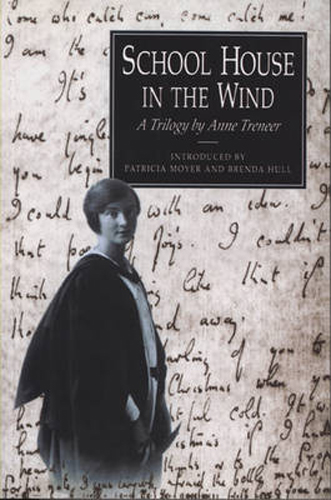
School House in the Wind
A Trilogy by Anne Treneer
By (author) Anne Treneer Introduction by Brenda Hull Introduction by Patricia Moyer
Paperback (Published)
(May 1998)
ISBN: 9780859895125
5.31 x 7.95 inches
Price: $23.00
In stock
Hardback (Published)
(May 1998)
ISBN: 9780859895118
5.31 x 7.95 inches
Price: $70.00
On back order
Long out of print and now published together for the first time, these three volumes of autobiography of the Cornish author and schoolteacher Anne Treneer cover the period from her birth at Gorran in 1891 to her retirement from teaching in 1948. The first volume, School House in the Wind, covers her early childhood in Cornwall until 1906. Cornish Years takes her to Truro, Exmouth and Exeter, and from there to Camborne, Liverpool and Lady Margaret Hall, Oxford. A Stranger in the Midlands covers the years between 1931 and 1947, when she taught at King Edwards High School for Girls in Birmingham. As well as a substantial introduction, the book includes a short biography of Anne Treneer, continuing her story to her death in 1966, and a descriptive bibliography of her writings.
Brenda Hull is an independent researcher in Cornwall and honorary editor of the Journal of the Cornwall Association of Local Historians. Patricia Moyer is a visiting scholar in the Department of English, University of North Carolina and an honorary research fellow in the Centre for Women’s Studies, University of Exeter. She lives and writes for part of each year in Anne Treneer country in Cornwall.
- By (author) Anne Treneer
- Introduction by Brenda Hull
- Introduction by Patricia Moyer
"The books are full of delights - evocations of the landscape in Cornwall, of the Malvern Hills and the Bredon County. And her insights into the educational system in which she taught, with occasional theraputic breaks, for forty or so years are fascinating. How she would have hated the Gradgrind and Bounderby ethos of current education. The books create a picture of a character talented, loveable and essentially wise." Devon and Cornwall Notes and Queries, Spring 1999 "There is much here to reflect upon, about gender, identity, work and women's lives. But that is only part of the story. Treneer writes with extraordinary sensitivity about her childhood in Cornwall, and about the countryside and natural history wherever she lived and worked. She has a sharp eye for detail, and an irreverent sense of humour. Her story is absorbing, and deserves a wider audience". Social History Bulletin, Vol. 23, No. 2, Autumn 1998 "Anne Treneer was the last of the great stylists among Cornish authors writing in English. She takes her place with "Q" and A.L. Rowse at the high water mark of good writing. She is a mistress of the arresting phrase, the happy shaft of wit, the illuminating picture of life around her, continually celebrating the Cornwall she knew and loved." Cornish World, September/November 1998 "Anne Treneer's books have been out of print for too long. Her autobiography is a celebration-of Cornwall, of a love of life and literature, of the joy of education, of everything that is positive and pleasurable-and a fine example of the craft of the wordsmith which makes a thoughtfully written book deceptively easy to read." (CALH Newsletter, Autumn 1998) " ... Some of the best writing about Cornwall which has ever been published, her descriptions surging with the shape and colour of the land itself ..." Devon Life, September 1998
—
The books are full of delights - evocations of the landscape in Cornwall, of the Malvern Hills and the Bredon County. And her insights into the educational system in which she taught, with occasional therapeutic breaks, for forty or so years are fascinating. How she would have hated the Gradgrind and Bounderby ethos of current education. The books create a picture of a character talented, loveable and essentially wise.
—
There is much here to reflect upon, about gender, identity, work and women's lives. But that is only part of the story. Treneer writes with extraordinary sensitivity about her childhood in Cornwall, and about the countryside and natural history wherever she lived and worked. She has a sharp eye for detail, and an irreverent sense of humour. Her story is absorbing, and deserves a wider audience.
—
Anne Treneer was the last of the great stylists among Cornish authors writing in English. She takes her place with "Q" and A.L. Rowse at the high water mark of good writing. She is a mistress of the arresting phrase, the happy shaft of wit, the illuminating picture of life around her, continually celebrating the Cornwall she knew and loved.
—
Anne Treneer's books have been out of print for too long. Her autobiography is a celebration-of Cornwall, of a love of life and literature, of the joy of education, of everything that is positive and pleasurable-and a fine example of the craft of the wordsmith which makes a thoughtfully written book deceptively easy to read.
—
. . . Some of the best writing about Cornwall which has ever been published, her descriptions surging with the shape and colour of the land itself . . .
—
Similar Books



 Ars Prophetica
Theology in the Poetry of Twentieth-Century Hebrew Poets Avraham Halfi, Shin Shalom, Amir Gilboa, and T. Carmi


 Cahiers de l’Association internationale des études françaises
J. M. G. Le Clézio - Enseigner les littératures francophones aujourd’hui - Récit de soi et expérience de l’illusion (XVIIe-XVIIIe siècles)
Volume 78
 Cahiers de littérature française
Les Métamorphoses du texte. Enjeux intertextuels et transpositions visuelles
Volume 25
 Cahiers de recherches médiévales et humanistes – Journal of Medieval and Humanistic Studies
Volume 51
 Cahiers de sémiotique des cultures
Ponctuation et sens. Nouvelles perspectives / Punctuation and meaning. New perspectives
Volume 6


 CompLit
Myth, Folklore and Magic in European Literatures. Critical and Contemporary Reconfigurations


 Dis/United States of Vulnerability
Literary and Cultural Transgressions in U.S. Poetry Since the 1960s
Volume 330


 European Drama and Performance Studies
Dramatisations politiques. Théâtre, politique et idéologie au XIXe siècle (1806-1914)
Volume 27


 La Lettre clandestine
La littérature philosophique clandestine, ses éditeurs et ses éditions
Volume 34


 La Revue des lettres modernes
« Afin que rien ne meure ». Le deuil dans et de l’œuvre de Marguerite Duras
Volume 9

