
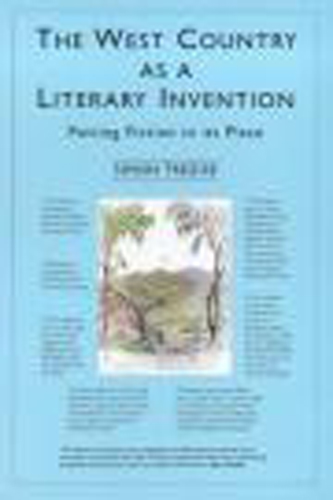
The West Country As A Literary Invention
Putting Fiction in its Place
By (author) Simon Trezise
Paperback (Published)
(September 2000)
ISBN: 9780859895385
6.14 x 9.21 inches
Price: $26.00
In stock
Hardback (Published)
(September 2000)
ISBN: 9780859895378
6.14 x 9.21 inches
Price: $112.00
In stock
Is the ‘West Country’ on the map or in the mind? Is it the south-west peninsula of Britain or a semi-mythical country offering a home for those in pursuit of the romance of wrecking, smuggling and a rural Golden Age? This book investigates these questions in the context of the relationship between place and writing, discussing Thomas Hardy’s Wessex; R.D. Blackmore’s Exmoor and Lorna Doone; Charles Kingsley, whose Westward Ho!, became a Devon place-name, Sabine Baring-Gould of Dartmoor and recorder and inventor of West Country folk-tales; Parson Hawker of Morwenstowe, an inventor of the Cornish King Arthur.
Keywords - region, topography, provincial, landscape, chronotope
Parson Hawker's Inventions - Trelawney, Cruel Coppinger and the Cornish King Arthur
Westward Ho! or Charles Kingsley's inventions - Elizabethans viewed through Victorian spectacles
tales from the telling house - the many authors of Lorna Doone
from the West Country into Wessex - Thomas Hardy
Sabine Baring-Gould - novels and folk songs of Devon and Cornwall
conclusion - from the Victorians to the 20th century,
Contents: Parson Hawker's Inventions - Trelawney, Cruel Coppinger and the Cornish King Arthur; Westward Ho! or Charles Kingsley's inventions - Elizabethans viewed through Victorian spectacles; tales from the telling house - the many authors of Lorna Doone; from the West Country into Wessex - Thomas Hardy; Sabine Baring-Gould - novels and folk songs of Devon and Cornwall; conclusion - from the Victorians to the 20th century.
The late Simon Trezise was a lecturer in literature at the University of Exeter and had worked as a Tutor-Counsellor for the Open University. He lived and worked in many parts of the West Country.
- By (author) Simon Trezise
"Trezise convincingly demonstrates with clarity and in painstaking detail that certain authors were highly influential in creating the perception of a West Country that has held sway since Victorian times and in contributing to a sense of region and place ... a bonus is provided in the numerous entertaining and informative digressions from the central purpose of the book." The Devon Historian, Vol. 63, Oct 2001 "This book is a valuable contribution to topoliterary studies and the social history of the region." The Totnes Historian, No. 4, 2001/02 "Eight meaty chapters ... a tour de force of scholarly research ... I do seriously recommend this book." The Sabine Baring-Gould Appreciation Society Newsletter, No 35, 2001 "An exhaustive account ... probably the most comprehensive single account of the development of the cinema in the nineteenth century." Sight and Sound, February 2001 "At last we have a well-crafted critical volume which considers the construction of the 'West Country' in literature ... His research is very thorough in each of the writers considered-so much so that this work is likely to be the definitive regional assessment of these works for some time to come ... Throughout this brilliant volume Trezise has reassessed many of the classic texts and writers whom we associate with the region. This book has been long overdue. Its research and readability-not to mention its innovation in dealing with a neglected literary landscape-make it one of the essential purchases of the new millennium." Cornish History Network Newsletter, December 2000, Issue 9 "A penetrating and challenging examination of the effect of certain landscapes on several writers of eminence and significance, and of the subsequent (and often unforeseen and unintended) effect of these writers on the very landscapes of which they write ... Simon Trezise's book will cause us to re-examine some old and favourite authors in a new light." Western Morning News, Nov 7, 2000 "The literary and topographical range of this study is comprehensive. Six essays, each devoted to a West Country author, take us from Thomas Hardy at Egdon Heath to Virginia Woolf contemplating the Godrevy Lighthouse ... Sabine Baring-Gould is summarized as 'the amanuensis of West Country people', and on the evidence of this book, the same could be said of Simon Trezise." Times Literary Supplement, December 1, 2000 "Fascinating ... this is a densely-packed book, animated by enthusiasm and buttressed by meticulous research." New Welsh Review, Spring 2001, No 52, 82-3
—
“Trezise convincingly demonstrates with clarity and in painstaking detail that certain authors were highly influential in creating the perception of a West Country that has held sway since Victorian times and in contributing to a sense of region and place . . . a bonus is provided in the numerous entertaining and informative digressions from the central purpose of the book.” (The Devon Historian, Vol. 63, Oct 2001)
“This book is a valuable contribution to topoliterary studies and the social history of the region.” (The Totnes Historian, No. 4, 2001/02)
“Eight meaty chapters . . . a tour de force of scholarly research . . . I do seriously recommend this book.” (The Sabine Baring-Gould Appreciation Society Newsletter, No 35, 2001)
“An exhaustive account . . . probably the most comprehensive single account of the development of the cinema in the nineteenth century.” (Sight and Sound, February 2001)
“At last we have a well-crafted critical volume which considers the construction of the “West Country” in literature . . . His research is very thorough in each of the writers considered—so much so that this work is likely to be the definitive regional assessment of these works for some time to come . . . Throughout this brilliant volume Trezise has reassessed many of the classic texts and writers whom we associate with the region. This book has been long overdue. Its research and readability—not to mention its innovation in dealing with a neglected literary landscape—make it one of the essential purchases of the new millennium.” (Cornish History Network Newsletter, December 2000, Issue 9)
“A penetrating and challenging examination of the effect of certain landscapes on several writers of eminence and significance, and of the subsequent (and often unforeseen and unintended) effect of these writers on the very landscapes of which they write . . . Simon Trezise’s book will cause us to re-examine some old and favourite authors in a new light.” (Western Morning News, Nov 7, 2000)
“The literary and topographical range of this study is comprehensive. Six essays, each devoted to a West Country author, take us from Thomas Hardy at Egdon Heath to Virginia Woolf contemplating the Godrevy Lighthouse . . . Sabine Baring-Gould is summarized as “the amanuensis of West Country people”, and on the evidence of this book, the same could be said of Simon Trezise.” (Times Literary Supplement, December 1, 2000)
“Fascinating . . . this is a densely-packed book, animated by enthusiasm and buttressed by meticulous research.” (New Welsh Review, Spring 2001, No 52, 82-3)
—
Similar Books


 Ars Prophetica
Theology in the Poetry of Twentieth-Century Hebrew Poets Avraham Halfi, Shin Shalom, Amir Gilboa, and T. Carmi


 Cahiers de l’Association internationale des études françaises
J. M. G. Le Clézio - Enseigner les littératures francophones aujourd’hui - Récit de soi et expérience de l’illusion (XVIIe-XVIIIe siècles)
Volume 78
 Cahiers de littérature française
Les Métamorphoses du texte. Enjeux intertextuels et transpositions visuelles
Volume 25
 Cahiers de recherches médiévales et humanistes – Journal of Medieval and Humanistic Studies
Volume 51
 Cahiers de sémiotique des cultures
Ponctuation et sens. Nouvelles perspectives / Punctuation and meaning. New perspectives
Volume 6


 CompLit
Myth, Folklore and Magic in European Literatures. Critical and Contemporary Reconfigurations


 Dis/United States of Vulnerability
Literary and Cultural Transgressions in U.S. Poetry Since the 1960s
Volume 330


 European Drama and Performance Studies
Dramatisations politiques. Théâtre, politique et idéologie au XIXe siècle (1806-1914)
Volume 27


 La Lettre clandestine
La littérature philosophique clandestine, ses éditeurs et ses éditions
Volume 34


 La Revue des lettres modernes
« Afin que rien ne meure ». Le deuil dans et de l’œuvre de Marguerite Duras
Volume 9

