
Introducing the Lambeth Bible
A Study of Text and Imagery
By (author) Dorothy Shepard
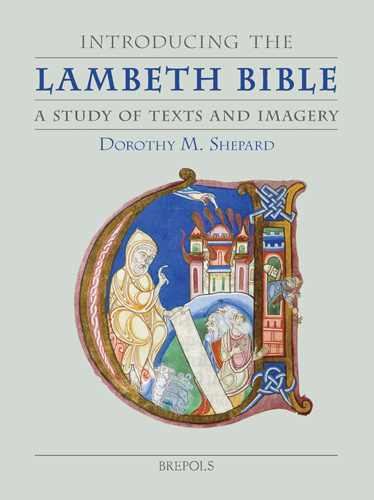
This study of the two-volume Lambeth Bible, one of the premier Romanesque giant bibles, concerns itself with its textual makeup as well as its magnificent illumination. It reports the results of research on texts and imagery found in over a hundred English and continental Romanesque Bibles. Comparative study of the prefatory materials in these Bibles yielded significant new understandings of their importance and represents a major conclusion of this study. They are important aids in establishing places of origin of biblical manuscripts and in the study of the illumination chosen for them. Exhaustive study of the prologues, chapter lists, and other miscellaneous texts in both volumes of the Lambeth Bible and other English Bibles, has helped to establish that the Lambeth Bible was not made at St. Albans or at Christ Church, Canterbury, two of the sites often suggested for its production. Six beautiful miniatures and thirty-one historiated initials remain in the Lambeth Bible so examination of their iconography is a major aspect of this book. This study includes both a search for visual and textual models for the imagery used in the Lambeth Bible and an investigation of the significance of those subjects in the twelfth century. In a surprising number of cases a relationship existed between the prologue preceding a biblical book and the imagery with which it was illuminated. Thus what initially seemed to be isolated instances of drawing inspiration from the prologues was in fact a customary practice of the makers of the Lambeth Bible.
This study of the two-volume Lambeth Bible, one of the premier Romanesque giant bibles, concerns itself with its textual makeup as well as its magnificent illumination. It reports the results of research on texts and imagery found in over a hundred English and continental Romanesque Bibles. Comparative study of the prefatory materials in these Bibles yielded significant new understandings of their importance and represents a major conclusion of this study. They are important aids in establishing places of origin of biblical manuscripts and in the study of the illumination chosen for them. Exhaustive study of the prologues, chapter lists, and other miscellaneous texts in both volumes of the Lambeth Bible and other English Bibles, has helped to establish that the Lambeth Bible was not made at St. Albans or at Christ Church, Canterbury, two of the sites often suggested for its production. Six beautiful miniatures and thirty-one historiated initials remain in the Lambeth Bible so examination of their iconography is a major aspect of this book. This study includes both a search for visual and textual models for the imagery used in the Lambeth Bible and an investigation of the significance of those subjects in the twelfth century. In a surprising number of cases a relationship existed between the prologue preceding a biblical book and the imagery with which it was illuminated. Thus what initially seemed to be isolated instances of drawing inspiration from the prologues was in fact a customary practice of the makers of the Lambeth Bible.
- By (author) Dorothy Shepard
Similar Books
 «Solazoxa festa, stradolze e stracomplia»
Festschrift für Raymund Wilhelm zum 65. Geburtstag mit Beiträgen zu Diskurstraditionen und mittelalterlicher Philologie
Volume 249
 A Collaborative Tapestry in Honour of Shirley Ann Brown / Une fresque brodée en l’honneur de Shirley Ann Brown
The Bayeux Tapestry Seen by her Colleagues and Friends / La Tapisserie de Bayeux vue par ses collègues et amis




 Balthasar Caymox of Nuremberg
Early Modern German Print Publishers: Popular Prints of the Seventeenth Century
 Behind the Scenes of Medieval Roofs
An Overview of the Roofing Systems of Italian Churches
Volume 90


 Cahiers de recherches médiévales et humanistes – Journal of Medieval and Humanistic Studies
Volume 51





 ENTANGLED AFRICA
Intra-African Relations Between Rain Forest and Mediterranean from Around 4,000 BCE to 1,500 CE



 Gold, Silver and Glass: Power Networks, Cultural Identities, Technology Transfers and Agency across the Old World (7th Century BC – 1st Century AD)
Proceedings of a Conference Held at the British Museum, 16–18 June 2023


 Innovation and Medieval Communities
The Circulation of Ideas and Practices in and out of the Town (1200-1500)
Volume 63
 John Dunstaple Reading Boethius
John Dunstaple’s Annotations to Boethius’s “De institutione musica” in the Manuscript Oxford, Corpus Christi College Library, MS 118
 Legal Visuality
Exegesis, Ambiguity, and Dissimulation of the Donation of Constantine in the Early Modern Period
 Listening to the Swan Song
More-than-Human Beings and Sounds in Literature and Culture Through the Ages


 Medieval Debates on Foreknowledge: Future Contingents, Prophecy, and Divination
Acts of the XXVII Annual Colloquium of the SIEPM, Trento 12-15 September 2023
Volume 31