
Emblematic Paintings from Sweden’s Age of Greatness
Nils Bielke and the Neo-Stoic Gallery at Skokloster
By (author) S McKeown
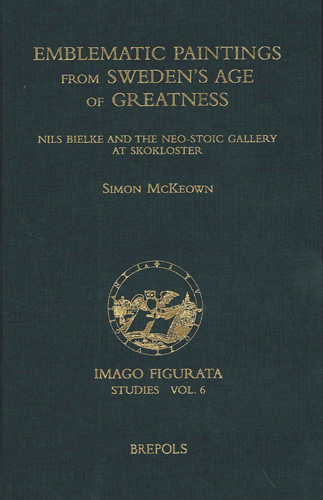
Emblematic Paintings of the Swedish Baroque is the first full-length study of the cycle of emblematic canvases hanging in the corridors at Skokloster Castle outside Stockholm. These imposing paintings were commissioned by a wealthy nobleman and cultural patron from Sweden’s Age of Greatness and were inspired by images from one of the most important emblem books of the seventeenth century, Otto VAenius’s Emblemata Horatiana. The principal importance of the Skokloster paintings lies in the fact that they appear to be a unique instance of paintings wholly adapted from images in a printed emblem book, a phenomenon never previously recorded in emblem studies. As such, they prompt questions about the place of the emblem within the fine and applied arts, generic issues explored in some detail in the introductory essay. The study presents a detailed reconstruction of the paintings’ place within a lost decorative milieu at the Uppland castle of Salsta, and offers interpretations of the role emblems played within its wider conceptive framework. The appeal of VAenius to the commissioning patron is also examined, and through this, a broader consideration of the reception of literary emblematics in seventeenth-century Sweden. This marks a significant attempt at opening up the rich subject of the emblem in Sweden, a national tradition hitherto largely neglected and little understood within emblem studies. Emblematic Paintings of the Swedish Baroque is the result of extensive field and archival research in major public and private collections in Sweden, and documents a historically significant group of artworks little known outside Scandinavia. The introductory essay presents the necessary groundwork of the pictures’ date, provenance, and probable circumstances of commission, as well as an extended reconstruction of the original context in which they were first displayed. Establishing that they were originally owned by Count Nils Bielke, the study examines the intellectual preoccupations of a Swedish nobleman, and the reasons he found the Neo-Stoic ideas promoted in VAenius’s emblems conducive to his interests and tastes. The study situates the Skokloster paintings within the intellectual framework of Great Power Sweden, conceiving of the pictures as attempts at private self-representation, but concomitantly aesthetic expressions of the nationalist-mytholopoeic movement promoted by the scholars Olof Rudbeck, Johan Peringskiold, and Urban Hjarne. This volume presents the paintings as an emblem text, reassembling the paintings in the order in which they occur in VAenius, and providing each with a commentary on iconography, sources, and analogues. Each plate is accompanied by a moralizing gloss by the seventeenth-century French author and editor of VAenius, Marin Le Roy, Sieur de Gomberville in the translation of Thomas Mannington Gibbs.
Emblematic Paintings of the Swedish Baroque is the first full-length study of the cycle of emblematic canvases hanging in the corridors at Skokloster Castle outside Stockholm. These imposing paintings were commissioned by a wealthy nobleman and cultural patron from Sweden’s Age of Greatness and were inspired by images from one of the most important emblem books of the seventeenth century, Otto VAenius’s Emblemata Horatiana. The principal importance of the Skokloster paintings lies in the fact that they appear to be a unique instance of paintings wholly adapted from images in a printed emblem book, a phenomenon never previously recorded in emblem studies. As such, they prompt questions about the place of the emblem within the fine and applied arts, generic issues explored in some detail in the introductory essay. The study presents a detailed reconstruction of the paintings’ place within a lost decorative milieu at the Uppland castle of Salsta, and offers interpretations of the role emblems played within its wider conceptive framework. The appeal of VAenius to the commissioning patron is also examined, and through this, a broader consideration of the reception of literary emblematics in seventeenth-century Sweden. This marks a significant attempt at opening up the rich subject of the emblem in Sweden, a national tradition hitherto largely neglected and little understood within emblem studies. Emblematic Paintings of the Swedish Baroque is the result of extensive field and archival research in major public and private collections in Sweden, and documents a historically significant group of artworks little known outside Scandinavia. The introductory essay presents the necessary groundwork of the pictures’ date, provenance, and probable circumstances of commission, as well as an extended reconstruction of the original context in which they were first displayed. Establishing that they were originally owned by Count Nils Bielke, the study examines the intellectual preoccupations of a Swedish nobleman, and the reasons he found the Neo-Stoic ideas promoted in VAenius’s emblems conducive to his interests and tastes. The study situates the Skokloster paintings within the intellectual framework of Great Power Sweden, conceiving of the pictures as attempts at private self-representation, but concomitantly aesthetic expressions of the nationalist-mytholopoeic movement promoted by the scholars Olof Rudbeck, Johan Peringskiold, and Urban Hjarne. This volume presents the paintings as an emblem text, reassembling the paintings in the order in which they occur in VAenius, and providing each with a commentary on iconography, sources, and analogues. Each plate is accompanied by a moralizing gloss by the seventeenth-century French author and editor of VAenius, Marin Le Roy, Sieur de Gomberville in the translation of Thomas Mannington Gibbs.
- By (author) S McKeown
Other Titles in this Series
 Emblemata sacra
Rhetorique et hermeneutique du discours sacre dans la litterature en images. The Rhetoric and Hermeneutics of Illustrated Sacred Discourse
Volume 7

 The Jesuits and the Emblem Tradition
Selected Papers of the Leuven International Emblem Conference, 18-23 August, 1996
Volume 1

Similar Books
 A Collaborative Tapestry in Honour of Shirley Ann Brown / Une fresque brodée en l’honneur de Shirley Ann Brown
The Bayeux Tapestry Seen by her Colleagues and Friends / La Tapisserie de Bayeux vue par ses collègues et amis



 Ars Prophetica
Theology in the Poetry of Twentieth-Century Hebrew Poets Avraham Halfi, Shin Shalom, Amir Gilboa, and T. Carmi

 Balthasar Caymox of Nuremberg
Early Modern German Print Publishers: Popular Prints of the Seventeenth Century


 Cahiers de littérature française
Les Métamorphoses du texte. Enjeux intertextuels et transpositions visuelles
Volume 25


 European Drama and Performance Studies
Dramatisations politiques. Théâtre, politique et idéologie au XIXe siècle (1806-1914)
Volume 27


 Legal Visuality
Exegesis, Ambiguity, and Dissimulation of the Donation of Constantine in the Early Modern Period
 LiCArC
Trauma et création artistique : l’engagement des artistes arabes dans des dynamiques de résiliences
Volume 14





 Monastic Manuscripts from the Eastern Mediterranean (Sinai, Jerusalem, Antioch)
Production, Use, and Contexts
 Naples as Laboratory / Laboratorium Neapel
Style Options, Artistic Rivalry and Self Fashioning in Neapolitan Baroque Painting / Plurale Stilbildung, Kunstlerkonkurrenz und Self Fashioning in der neapolitanischen Barockmalerei


 Nurturing the Elite
Representations of Drinking, Eating, and Religious Vessels in Palmyrene Funerary Iconography
Volume 13
